Have more people seen You Can See Everything (2026) than took a blood test from Theranos? Theaters have been sold out for the documentary co-directed by Lance Oppenheim and Nathan Fielder. The film takes an intimate, close-up look on the life of Silicon-Valley founder, Elizabeth Holmes and her family in the month leading up to her imprisonment for defrauding investors in her bio-tech company, Theranos. At the half-way mark of the film, it turns back to reflect on filmmaking as its own form of fraud and to reflect on all of our own attractions to performances, personas, and deceptions of all kinds that proliferate between and across the tech world and media environment. It is a love story about falling for a conman up until the point it becomes uncomfortable with its own intimacy with conmen and tries to create some distance with the help of actress Amanda Seyfried, Holmes’s double from the mini-series The Dropout (2022), who functions as a mediator by dialoguing with Fielder and his subjects, and as mediation, by creating a double to the woman we had been watching.
But as I sat in a full theater during the early morning screening when I could get tickets, I was left wondering about the medicine missing at the core of the film. What kind of love story is our affair with medical fraud?
Elizabeth Holmes and Billy Evans tell Nathan Fielder that they granted him permission to document Holmes because of a clip of Fielder talking to someone “at a gas station.” Presumably, they are referring to a scene from the Comedy Central show “Nathan for You” (2013-8), in which Fielder plays a low-budget business consultant, goading his clients into attempting hair-brained, “scam” schemes while maintaining his own deadpanned seriousness. In the scene at the gas station, Fielder’s normally placid look falters into shock as the gas station owner, whom Fielder is nominally helping but is actually mining for funny moments, reveals that he has sipped “a little bit” of his grandson’s pee. It is a practice that has existed across different cultures at different times to express intimacy, spiritual connection between generations, and – crucially – as a part of medical practice.[1] In the documentary, this revelation of the film’s origins – that Evans and Holmes admire this interaction – occurs in a re-enactment, in which celebrity actors play the roles of Holmes and Evans. This purposefully fictional frame has animated a wave of discourse about documentary ethics, tech scams, and gender performance since it draws purposeful parallels between Holmes’s fraud, the narrative fictions of film, and a contemporary culture grabbling with the widespread love and loathing for scams of all kinds—whether social media performances or inflating IPOs. What is missed by focusing on the frame is the stuff in the middle, or, if you will, the piss in the middle – the messy material of the body that Holmes’s company wants to minimize and that the film seems conflicted about – like Fielder’s complex expression in the gas station.
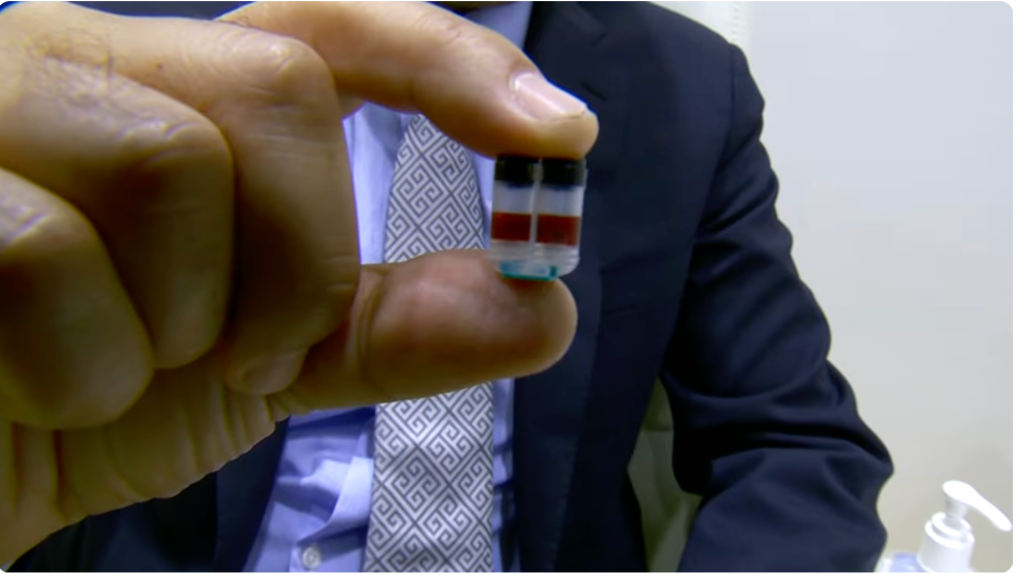
Holmes company Theranos promised that a single drop of blood could alone be tested for a slew of health markers. The fraud, clear to many biologists from the start, was that, simply, more blood is needed to test for the kind of illnesses and biomarkers that Holmes claimed to test for—cholesterol, cancer, HIV. One of the company’s original whistleblowers, Tyler Shultz has run a small press circuit in the wake of the movie with the seemingly single-minded purpose of clarifying the “rudimentary” science at work in Holmes’ device. In one scene that Shultz finds particularly frustrating, Holmes and Fielder debate the meaning of Holmes’ statement in an interview in which she claimed her device could run any test. While the film splits hairs over the meaning of “can” in the statement, “the device can run any test,” the lie is in the subject and not the verb: a drop of blood cannot run any test.
The fantasy that Holmes sold was a fantasy that one could do away with – automate – the tedious and intensive care that goes into collecting blood and running tests – that she could automate nursing and lab work. Now, when one gets their blood tested for the variety of ailments and biomarkers that Theranos claimed to test for, often, a nurse inserts an IV and fills up several vials of blood. The fantasy is to shorten this procedure which involves touch, sensitivity, and timing. The fantasy is that all that activity and all that expertise can disappear into a black box. It is a fantasy. Marxists imagined on the horizon a utopia without labor as factories increasingly automated, and Marxist-Feminists have been quick to point out that there seems to be some scientific impossibility to handing over care work to the cold hands of a robot. Silvia Federici puts it rather definitively that “this work has proven not to be easily replaced by mechanization.”[2] Citing Nancy Folbre, Federici evidences this claim by rehearsing a list of ways that, by 2009, technology has augmented care – from “nursebots” to monitoring devices to wheelchairs – but lands on how each of these forms cannot address the emotional and sensual features of care.
Holmes seem intent on presenting herself as someone capable of the emotional and sensual features of care. The foundation of the lie she perpetuates in the film is that her heart was in the right place. From what the viewer can access of Holmes’ and Evans’ intentions for the documentary (and we are asked repeatedly to question those), we can make some guesses: they want to tell, as they put it, “a human story.” They intended to wring sympathy from the audience by reminding us of the horrors of the American prison system – that an incarcerated mother will be separated from her children. Body fluids play a role here too. In one of the last conversations between Holmes and her family that we see, she tells Evans that she has left breastmilk in the fridge. For the half of the movie in which Fielder and his co-director film Holmes herself, she is almost always holding a baby. At one point, while around the dinner table with Fielder, she pulls up her plush, camel-colored sweater to breastfeed. In discussion of the film, much has been made of Evan’s full-frontal nudity but less of this intentional exposure. If Holmes is seducing Fielder and the audience, she does so – or wishes to do so – through her maternity, her care. In that same staged scene in which Evans and Holmes discuss Fielder’s gas station interview about drinking a grandson’s pee – as Fielder remembers it – Holmes tells Fielder that he would make a good father. It is striking to me that in addition to correcting the science shown in the movie, whistleblower Tyler Shultz wants to correct this image of the caring person too. He writes in his op-ed, “I do not believe that Elizabeth started Theranos with the intent to defraud investors of hundreds of millions of dollars, and I also do not believe that she started Theranos wanting to help patients.” One kind of good intentions does not lead to the other. One kind of care (maternal) is not always the same as another (medical). One cannot perform and lie their way into making medicine work.
The version of the film Holmes and Evans imagined, perhaps, wanted to re-entangle science and care that the company sought to disentangle, to bring back the fussiness, awkwardness, and intimacy of medicine. But the film will not let them. The first half of the film has two competing background tracks: children fussing and Evans watching YouTube videos about basic biology on two-times speed. This pairing is played for laughs, and it is in fact funny to hear a voice rush through molecular structures. In pairing them, Holmes’ mothering comes to seem just as rushed and uncareful, and the film frequently suggests the children are tools for image manipulation, going as far as to question in one re-enactment whether it was planned for Holmes to check on the children at a certain point when negotiating the terms of the documentary. The audience watches a version where an actress as Holmes soothes a child and another version where the actress listens through the door. We are rightly invited to question Holmes’ new self-presentation and then rightly asked to question the filmmaking process that promises us some authentic version instead.
The film refuses all consideration of science, medical care, and body fluids – the stuff at the heart of Theranos. This refusal is striking. Fielder’s talent as a performance artist is to make things uncomfortable rather than comfortable, as if he were to bottle up the uncomfortable silence of sitting there and having your blood taken. As Naomi Fry points out her review of the film, Fielder creates and mines “forced intimacy,” and what is more forced than the intimacy we permit with our medical providers in order for them to care for us? If there is a thesis to the film, it is that regardless of how much we force intimacy, how much someone might let you in, you cannot quite know them and instead you are left, as the second half of the film shows, with imperfect memories and performances. In one exemplary moment, we watch a reenactment of a conversation between Fielder and Holmes pause so that Fielder can edit the script and run the scene again. It is funny to ask how intimate you can get with the founder of a testing company that seeks less intimacy in our medicine. Fielder at one point in the film offers a metaphor for his practice and for Holmes’: a magic trick that David Blaine once performed in which he stabbed an ice pick through his hand. The trick? He was actually stabbing his hand. Like an IV needle going into the arm, the pick can be carefully and gentle inserted. Blaine represents in, Sianne Ngai’s Marxist-Feminist thinking, one example of the gimmick, something at once working too hard and working too little. There is something cheap about making the body actually do the work, something cheap about really being poked and prodded to reveal something about someone.
At the start of the film, Fielder distances himself from the science and therefore the medicine that Holmes claims as her domain. He says that it is an “anxiety” for him that she picked him because he does not have the right background or suitable expertise to check her claims. But he does – like all of us – have experience and expertise as a patient, and I wonder whether he (the creator or his persona) would want the kind of blood test that Theranos was offering if the science had proven possible. The film’s co-director Lance Oppenheim has experience depicting the intimacy of body fluids in his 2024 film Spermworld. The film depicts in surreal, hazy imagery of a neon thriller the online, black market for sperm donation. Like You Can See Everything, it is a film about forced intimacy, the kind of intimacy one undertakes to enact a biological process, in this case, conception. The director marveled in an interview, however, about how non-intimate it was. He says, “And I was surprised that Kyle, the donor, had no interest in getting to know her [one of the film’s subjects] at all. It was, to him, a just purely, almost robotically transactional experience.” Might we want performance, transaction, and automation?
The movie reads like Grey Gardens (1975), two men’s filming the everyday life of eccentrics – Edith Beale and her daughter Edith Beale – an unprecedentedly close look at and exposure of our nation’s oligarchy, in which we are invited to gawk.[3] In its most iconic scene, “Little Eddie” laboriously puts on an underwhelming patriotic dance – she is at once working too hard and too little – and so the film raises questions about when performance falters. What if it we imagine in addition that You Can See Everything is like and in conversation with healthcare documentaries, like Michael Moore’s Sicko (2007) or Frederick Wiseman’s Hospital (1970) or Welfare (1975) or with Oppenheim’s Spermworld (2024)? These documentaries ask us to question the conditions under which we receive care. And, You Can See Everything – whether the film embraces it or not – shows us that we receive care under the conditions of complex performativity.
[1] For example, see Christopher Charles Taylor, Milk, Honey, and Money: Changing Concepts in Rwandan Healing (Smithsonian Institution Press, 1992), 65-106. But you also can find in the comments of the video many a person clarifying that they recognize this practice from different cultures.
[2] Silvia Federici, “On Elder Care” in Beyond Marx, ed. Marcel can der Linden and Karl Heinz Roth (Leiden, 2014), 248.
[3] See Stephanie Zacharek in Time for another review that makes this comparison.
Image credit: Inside the Theranos lab with Elizabeth Holmes, CNN/Youtube