How did an author’s gender influence seventeenth-century descriptions of women’s childbearing pains in medical and literary texts? Most English midwifery manuals were written by men with theoretical knowledge of the subject, but with little practical experience. Before the Middle Ages, there were no clear names for physicians or healers, but with the foundation of medieval universities, medicine became a profession, and women were excluded (Whaley 1). Women continued to heal on the margins of society, and they could still practice midwifery (2).
Even though texts on obstetrics existed, it was only in the sixteenth century that the publication of midwifery manuals increased in Europe (95). This increase was notably due to male physicians seeking to regulate midwifery practices (Whitt 67-68). The following century, women gained greater access to publishing, and the first female-authored midwifery texts also appeared. Seventeenth-century manuals written by male and female authors offer an interesting opportunity to contrast the gendered aspects of this profession.
This article demonstrates how male medical writers justified childbearing pain through religious terminology, while their female counterparts did not. This conflation fed into the literature of the period, further cementing the idea that women’s physical pain was divinely ordained. By examining different genres such as medical texts and poetry in this article, it is apparent that the gender of the authors impacted the representation of women’s pain, its origins, and its consequences.
In 1609 Louise Bourgeois Bouriser, midwife to the Queen of France, Marie de Medici, published the first work in French by a female midwife, Diverse Observations on Sterility, Miscarriage, Fertility, Childbirths, and Diseases of Women and Newborn Children (Observations diverses sur la stérilité, perte de fruict, fécondité, accouchements et maladies des femmes et enfants nouveau-nés). This work was republished multiple times, and an extract first appeared in English in Thomas Chamberlayne’s The Compleat Midwifes Practice (1656), demonstrating its international success. However, several changes were made to Boursier’s text when Chamberlayne’s version was published, most notably regarding women’s pain during childbirth and its theological origins.
In Boursier’s French text, she rarely references God but does so when discussing the ‘illnesses’ caused by the womb, which include childbearing. She states that without these ailments, “women could equal men in health, as much in bodily health as in health of mind. But God wanted to make them lesser in this way in order to avoid the jealousy that one sex might have felt towards the other” (Boursier 223). This section, however, is absent from the English translation. Boursier also references God when discussing a prolapsed womb as a consequence of childbirth. She states “I wish that all women afflicted with this problem would come see me, not because I want to profit from it, but because I want to honor God by relieving them of their distress. I write this in order to bid them boldly come.” (208). Again, this passage is absent from the English text. Chamberlayne does, however, reference Exodus 1.17 “But the midwives feared God, and did not as the king of Egypt commanded them, but saved the men children alive.” (KJV) While Boursier ties God to her desire to reduce pain in her patients, Chamberlayne highlights the midwives’ duty to obey God.
A few years later, in the middle of the seventeenth century, Nicholas Culpeper published his very successful midwifery manual, The Directory for Midwives (1651). This text was reprinted 17 times, with its last edition printed in 1777 (Thulesius 556). For Culpeper, women are “inferior versions of men; their bodies were described as variants of male anatomy” (Fissell Vernacular Bodies 143). In addition to their anatomical subordination, women were spiritually flawed because of Eve’s curse. Culpeper comments that ‘though Child-bearing since Eve’s sin is ordained to be painful as a [punishment thereof]’ (Culpeper 177). Culpeper overlaps his medical assessment of women with Eve, tying their physical pain to spiritual anguish, equally suggesting Eve’s curse is a justification for women’s pain.
Twenty years after Culpeper’s text was released, Jane Sharp, a seventeenth-century midwife with over 30 years of experience, published the first English midwifery guide written by a woman in 1671. Her discussion of childbearing pain is different from Culpeper’s approach. Even though Sharp draws inspiration from her male colleagues and predecessors, including Culpeper, she also brings her own understanding and expertise to her writing (Fissell “Review of the Midwives” 199-200). She mentions Eve eating of the forbidden fruit and its consequences on womankind: “Some there are who hold conception to be a curse, because God laid it upon Eve for tasting of the forbidden fruit” (Hobby 75-76). However, Sharp further comments that “encrease and multiply, was the blessing of God, it is not the conception, but the sorrow to bring forth that was laid as a curse” (76).1 By reshaping Eve’s curse into a blessing, Sharp moves childbearing away from its negative theological connotations towards a positive alternative.
A year after Sharp’s text was published, William Mauriceau’s The Disease of Women in Childbed (1672) was released.2 This text does not specifically reference Eve but does imply her sin: “Most people believe that there is no other reason for the cause of this evil, but because God hath so ordained it and that Woman, according to his Word, must bring forth with pain, because of her sin, according to what is written in the 3d. Chap. of Genesis” (Mauriceau 177). Mauriceau was a prominent French obstetrician, and this text was popular in both its original and English translations. Just like Culpeper’s text, Mauriceau’s manual references biblical passages as an explanation for women’s physical pain and does not offer any further medical explanation.
This overview of the representation of women’s gynaecological pain by male and female medical practitioners, respectively, demonstrates a divided approach. Even though Sharp and Boursier use spiritual language just as Culpeper and Mauriceau did, the female authors offer perspectives that move away from Eve’s punishment. A similar dichotomy appears in the literature of the period, which equally approaches childbearing pain through a religious lens, yet it is still divided by the authors’ genders.
In Paradise Lost (1667), John Milton describes the punishment Eve receives for eating the forbidden fruit:
“Thy sorrow I will greatly multiply
By thy conception: children thou shalt bring
In sorrow forth and to thy husband’s will
Thine shall submit: he overthee shall rule.” (X.193-196)
With these lines, Milton echoes Genesis 3:16: “Unto the woman he said, I will greatly multiply thy sorrow and thy conception; in sorrow thou shalt bring forth children; and thy desire shall be to thy husband, and he shall rule over thee.” (KJV) Milton’s poetry and male medical writers describe women’s pain by justifying it as a form of spiritual punishment.
Comparatively, Lucy Hutchinson describes Eve’s experiences of painful childbirth in her retelling of Genesis, Order and Disorder (1679):
Of the first mother’s disobedience,
Yet hath a promise that thereby she shall
Recover all the hurt of her first fall
When, in mysterious manner, from her womb
Her father, brother, husband, son shall come (V.221-229).
Just like the women midwife writers move away from the association between labour pains and Eve’s punishment, Hutchinson’s literary exploration of Genesis refocuses Eve’s childbearing on the importance of motherhood. Eve is the matriarch of mankind, and it is through her womb that “father, brother, husband, son shall come” (Hutchinson 229). Shannon Miller suggests that Hutchinson is revising both Genesis and Milton’s Paradise Lost “to suggest how maternal procreation can be used as a counter to seventeenth-century patriarchal theory” (109).
Since the womb is the location of ensoulment, where all humans receive their souls, it is impossible to avoid this organ’s spiritual connotations. The female authors quoted in this article do not deny this spiritual importance but demonstrate a desire to move away from the association between Eve’s curse and women’s bodies. Yet, male authors more clearly tie physical pain to spiritual failing. Although the female-authored texts attempt to suggest alternative narratives, a comparative analysis with male-authored texts betrays the gender dynamics at play that still haunt the understanding of women’s bodies today.
Notes:
- Hobby suggests this line is in reference to Genesis 1:28 “And God blessed them, and God said unto them, Be fruitful, and multiply, and replenish the earth, and subdue it: and have dominion over the fish of the sea, and over the fowl of the air, and over every living thing that moveth upon the earth.” (KJV)
- This text was first published in English in 1672, translated by Hugh Chamberlen. The original French text, Les Maladies des Femmes Grosses et Accouchées, was published in 1668 in Paris.
Works Cited:
Boursier, Louise Bourgeois. Midwife to the Queen of France: Diverse Observations, edited by Lingo, Alison Klairmont, translated by Stephanie O’Hara, Toronto, Canada: Iter Press, 2017.
Nicholas Culpeper, Directory for Midwives, or a Guide for Women. London: Peter Cole, 1662.
Fissell, Mary E. Vernacular Bodies: the Politics of Reproduction in Early Modern England. Oxford University Press, 2023.
— — —. “Review of the Midwives Book or the Whole Art of Midwifery Discovered.” NWSA Journal, vol. 13 no. 1, 2001, pp. 199-200. JSTOR, http://www.jstor.org/stable/4316800.
Hutchinson, Lucy. Order and Disorder. Edited by David Norbrook. Oxford, Malden Mass.: Blackwell, 2001.
Mauriceau, François. The Diseases of Women with Child, and in Child-bed. London: John Darby, 1672.
Miller, Shannon. Engendering the Fall: John Milton and Seventeenth-Century Women Writers. Philadelphia: University of Pennsylvania Press, 2008.
Sharp, Jane. The Midwives Book, or, the Whole Art of Midwifry Discovered. Edited by Elaine Hobby. Oxford University Press, 2023.
Thulesius, Olav. “Nicholas Culpeper, Father of English Midwifery.” Journal of the Royal Society of Medicine, vol. 87, no. 9, 1994, pp. 552-56.
Whaley, Leigh Ann. Women and the Practice of Medical Care in Early Modern Europe, 1400-1800. Palgrave Macmillan, 2011.
Whitt, Richard J. “Viewpoint in Eighteenth-Century Birthing Narratives: A Survey of Midwifery Manuals.” Women’s Writing, vol. 32, no. 1, 2025, pp. 66–84.
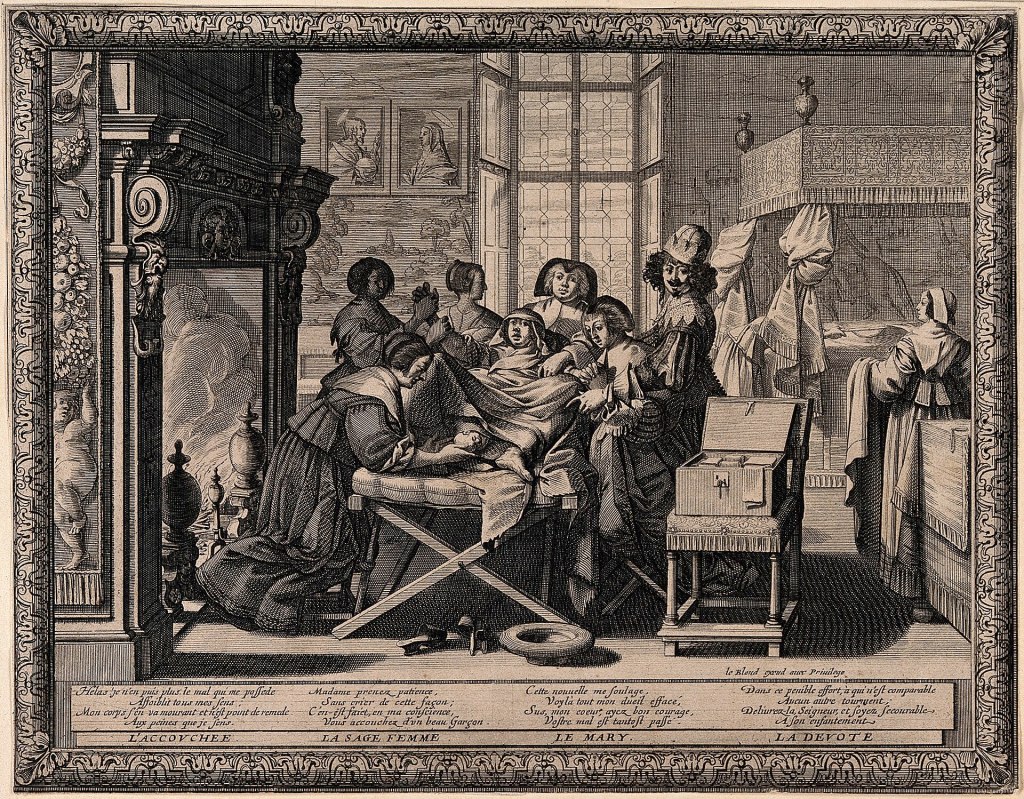
Cover image: A woman giving birth in an elaborate room aided by a midwife and a nun and surrounded by her husband and family. Engraving by A. Bosse. https://wellcomecollection.org/works/gt3g99nc