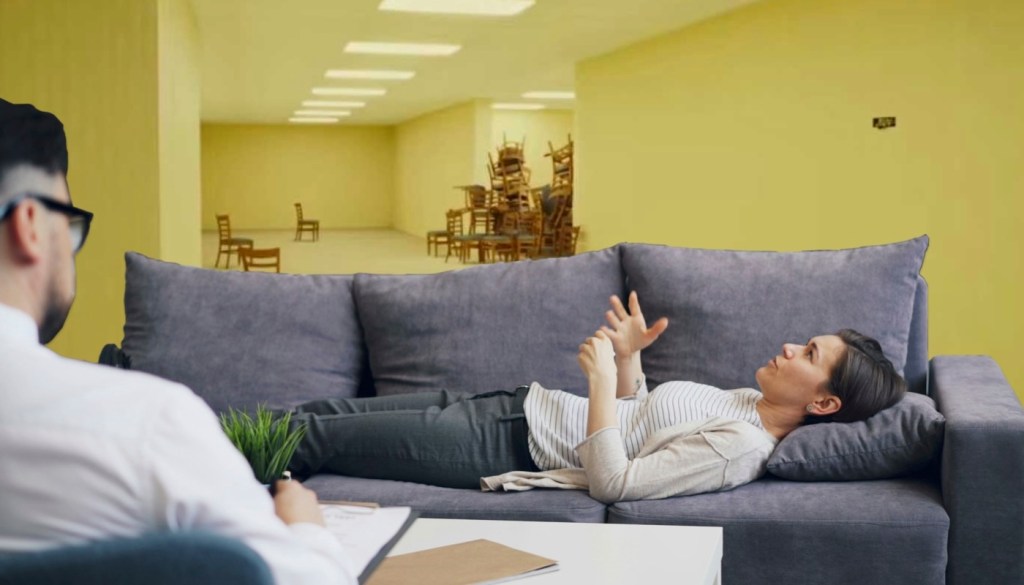
Consider the typical staging of a psychotherapy session: a patient lays on a couch, staring up at the ceiling, while a bespectacled therapist perches nearby and asks How does that make you feel? Psychotherapists have made a dramatic resurgence in recent films. Kane Parson’s horror flick Backrooms (2026), Olivia Wilde’s domestic satire The Invite (2026), and Mary Bronstein’s comedy-drama If I Had Legs I’d Kick You (2025) feature women working as psychotherapists, but their therapeutic practices stray from the traditional armchair-chaise longue nexus. These psychotherapists are not cryptic care providers taking clients in their consulting offices. Instead, they rely on digital media to create therapeutic encounters beyond the clinic. Such films perpetuate what I call ambient therapy: therapy that saturates an environment with a lo-fi, dissolute voice that soothes us from everywhere and nowhere, usually mediated through television screens, cassette tapes, and cellphones. The cool, feminine tone of ambient therapy promises clarifying reassurance or therapeutic solace anytime, anywhere. At first, ambient therapy seems to represent freedom—why hold psychotherapy in an office when you can post YouTube videos guiding clients to breathe in, breathe out in the quiet of their bedrooms?—but for women providing psychotherapy, this borderlessness becomes a form of grotesque enclosure.
Take, for example, Dr. Mary Kline, a stoic psychotherapist in Backrooms. Dr. Kline copes with the aftermath of her difficult childhood under the care of her mentally ill mother, while her client, Clark, grapples with midlife disappointments: his failed marriage; his waylaid career in architecture; his drinking problem. The movie opens with their psychotherapy sessions, but their psychic encounters move beyond the consulting room.
Backrooms displays ambient therapy through its sonic register. Dr. Kline often speaks in soft-voiced assurances, canned excerpts from her self-help book, The Window Within, which promises to help listeners break free from their behavioral infrastructures. Her ambient therapy appeals to the audience early in the film: “We all have our loops,” says Dr. Kline in a measured voiceover before describing the habits that keep us walking in circles. As viewers, we are treated to Dr. Kline’s abstract, gentle words and therefore encounter secondhand therapy. Ambient therapy also echoes inside the homes in the film, beyond clinical spaces. Dr. Kline eats dinner one evening and watches cable television, the TV glow bouncing off her face. The television suddenly flits to an advertisement of The Window Within. Dr. Kline’s purring voice spills from the TV, saying, “You can be the author of your own design, because we all deserve another chance to fulfill our dreams.” Dr. Kline’s voice fills the open spaces of the home, becoming a soft hum in the background of domestic life. Her book is also available on audiotape and can be listened to in other settings. Shortly after the scene, Clark is pictured driving his car, listening to the tapes that encourage him stop watching life unfold from behind a lone window, to open the window within.
Even conversations in clinical settings underscore the foamy borders between the personal and professional, the home and clinic. Early in the film, Dr. Kline meets with Clark in her office. Dr. Kline offers to role play his wife on the evening she leaves him and reopens an argument about his wife’s desire to go to law school:
Clark: What do you think happens if you do manage to graduate, you pop out a kid, and you leave me with the bill? Or am I stuck at home changing diapers because you’re too busy working for the first time in your life?
Dr. Kline: Now you’re being cruel.
Clark: I’m being honest. I thought that’s what you always wanted.
Dr. Kline: Just because you didn’t get to be an architect doesn’t mean—
Clark: I am a fucking architect! I’m just stuck selling shit furniture because someone won’t get off their fat fucking ass and help me!
After snapping at the therapist, Clark suddenly halts the exchange to clarify with whom he speaks: Dr. Kline or his former wife. She reassures him that the exercise is now over, and she is no longer playing the role of his wife.
Later, ambient therapy recasts this conversation in the backrooms. The film literalizes the labyrinth of childhood memories in its distorted, unending series of yellow-walled rooms populated with misshapen clusters of furniture. Backrooms—and the memories they represent—literally ensnare Dr. Kline and Clark. In the backrooms, Clark apprehends Dr. Kline and ties her to a chair at a staged kitchen table. At his command, Clark forces Dr. Kline to rehearse the same conversation from their therapy session while he brandishes a knife; she complies through gritted teeth, since her refusal to participate might result in deadly consequences. Therapy has transgressed beyond the borders of the consulting office, becoming a violent encounter of domestic enclosure.
Ambient therapies by women psychotherapists provide a constant, low-level hum that broadcast access, availability, ease: you can listen to them in the kitchen, the car, and the bedroom. Ambient therapy creates the swaddling sense of soothed reassurance, but Backrooms demonstrates how this access becomes a crisis of enclosure. Dr. Kline’s accessibility becomes weaponized into violent demand, far beyond the clinic; such access often defies separation between personal and professional therapeutic obligations. For women working as psychotherapists, ambient therapy portends freedom but becomes something brutal, worthy of the withering satires and horror films that portray them: a crisis of unbounded care.