Make no mistake: some looks kill. Jordan Peele’s Nope (2022) follows two families whose livelihoods depend on spectacle. The Asian Park family operates a Western-themed amusement park, while the Black Haywood family runs a horse-training business. Ricky “Jupe” Park remains haunted by Gordy, the chimpanzee he worked with as a child, who attacked his White castmates but spared him. Seeking answers, Jupe attempts to attract and tame Jean Jacket, a shape-shifting aerial predator. His attempt fails, and Jean Jacket kills his neighbor, Otis Haywood Sr. Now, Otis’s children, Otis Jr. (“OJ”) and Emerald (“Em”), must save their indebted ranch and family business, Haywood Hollywood Horses (Triple H). The business represents their American Dream, built on their Black immigrant ancestor’s contribution to film and their father’s purchase of the ranch despite White supremacy (Love 13). Both families seek security and recognition, but spectacle exposes them to danger.
In Nope, Jordan Peele uses Jean Jacket and the experiences of the Park and Haywood families to interrogate the purported inevitability of surveillance, through which White supremacy operates as a predatory force, threatening the survival, economic advancement, and enduring legacies of its human prey.
Nope connects technological surveillance with White supremacy from the beginning. Mickey and Gordy are the only non-White members of the otherwise all-White sitcom family in Gordy’s Home! Like Willis and Arnold from Diff’rent Strokes, they are comedic (Diogo 7) curiosities, echoing the racist pickaninny stereotype (Bogle 7). Cameras record their reactions to scripted charientisms from White castmates for the audience’s amusement. Their visibility turns difference into entertainment, not respect. Gordy’s portrayal as a chimpanzee in human clothing also recalls pseudoscience and the dehumanization of Black people through comparisons to monkeys (Diogo 10-13).
When a balloon pops and startles Gordy, he mauled his castmates, seemingly embodying another racist caricature: the Black brute or buck (Bogle, 13). Yet he approaches the terrified Jupe without attacking him and offers a fist bump. Gordy appears to recognize Jupe as an outsider. Jupe raises his fist, but animal control fatally shoots Gordy. Gordy is killed once his behavior no longer fits the role expected of him. The scene shows how racialized subjects can become spectacles, then threats when they stop performing as expected.
Jupe’s unresolved trauma may help explain his attempt to recreate the Gordy experience with Jean Jacket, an aerial predator that surveils those below with a microchip-like eye. Although it constantly watches others, it avoids being seen, disguising itself as a cloud or flying saucer. Those who look directly at it risk being attacked or killed. This behavior echoes White supremacy, whose structures can conceal threats, monitor subordinated people, and retaliate against those who challenge its dominance. Surveillance gives the watcher an advantage over people who do not know they are being targeted.
Jupe is one such person. Rather than learning from Gordy’s attack that wild animals are unpredictable, he convinces himself that he can communicate with predators. He risks his life and those of everyone at Jupiter’s Claim by trying to tame Jean Jacket. During his “Star Lasso Experience,” he uses horses purchased from the cash-strapped Haywoods as bait. Each performance retroactively tests whether Gordy recognized something exceptional in him. Jupe mistakes survival for evidence that he can control another predator. During his final performance, Jean Jacket consumes the audience. Mesmerized, Jupe remains fixed on the creature and waits to be taken. His fate illustrates the danger of confusing survival with mastery.
Through the Parks, Peele shows how ignorance and false confidence leave people vulnerable to predation. The family loses its members and its future in entertainment. Jean Jacket’s attack can also symbolize the erasure of the economic and social gains the Parks had made despite racism. A local newscaster later reports that the family and their guests have disappeared without a trace. The spectacle Jupe created to secure his family’s future instead consumes it.
The Haywoods offer a different model of survival. Despite losing a lucrative production opportunity, they refuse to surrender to Jean Jacket. Jupe, who had offered to buy their ranch, is dead, and Jean Jacket continues to threaten their horses, valuable assets. Unlike Jupe, the Haywoods seek to understand the threat. OJ studies Jean Jacket’s behavior and recognizes its behavioral patterns. The siblings learn that it responds to direct eye contact and that objects it perceives as living threats can provoke it. Their knowledge turns fear into a plan. Peele suggests that understanding a threat can create opportunities for resistance, whether it is a natural predator or a human-made system such as White supremacy and technological surveillance.
OJ leads through observation, expertise, and collaboration. He uses his knowledge of animal behavior to develop a strategy that limits the team’s exposure to danger. Em recruits Antlers Holst, a cinematographer with equipment to capture Jean Jacket, and Angel Torres, an electronics store employee. Angel helps install the ranch’s surveillance system and creates an early-warning system to track the creature. Together, they seek images that could secure the Haywoods’ future and preserve their business. Their plan relies on observation and teamwork, not the belief that the predator can simply be tamed.
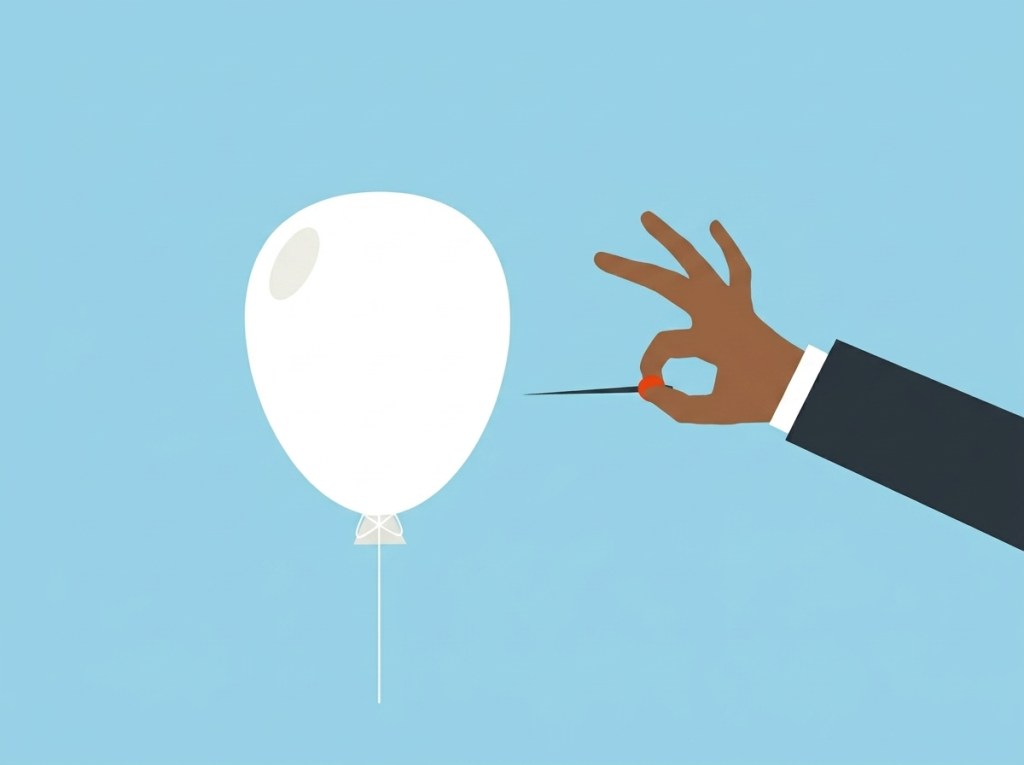
Their strategy succeeds. Em captures the photographs they need, while Antlers and Angel obtain footage. Jean Jacket meets its end after swallowing an inflatable figure and bursting like a balloon. The seemingly invincible predator is defeated through knowledge of its behaviors and vulnerability. More importantly, Em sees OJ alive. Their pursuit of economic security has not cost her brother his life. The ending leaves the Haywoods with the opportunity to continue their legacy.
Overall, Nope examines the relationship between technological surveillance and White supremacy. Peele explores how non-White people confront predatory systems while seeking survival, economic security, and legacy. Jean Jacket represents the convergence of racism, surveillance, and the supposed inevitability of a technologically constructed “jungle,” where the predator’s dominance appears absolute. Yet Peele challenges that inevitability, treating it as a paper tiger (Jackson 11). The predator has vulnerabilities, and understanding them makes resistance possible. The Haywoods survive by recognizing the threat, adapting, and working together. Their story rejects surrender and suggests that overwhelming power can be studied, challenged, and overcome.
Works Cited:
Bogle, Donald. Toms, Coons, Mulattoes, Mammies, and Bucks: An Interpretive History of Blacks in American Films. Viking Press, 1973.
Diogo, Rui. “Links between the discovery of primates and anatomical comparisons with humans, the chain of being, our place in nature, and racism.” Journal of morphology vol. 279,4 (2018): 472-493. doi:10.1002/jmor.20783
Jackson, George. Blood In My Eye. Black Classic Press, 1990.
Love, April. “Recognizing, Understanding, and Defining Systemic and Individual White Supremacy.” Women of Color Advancing Peace and Security 2022. (2022) http://dx.doi.org/10.2139/ssrn.4075353
Mohamed, Hasan. “Balloon-needle-pop-burst-hand-6792260.” Pixabay. 27 Nov. 2026, https://pixabay.com/vectors/balloon-needle-pop-burst-hand-6792260/