In his monumental novel, Les Misérables, French poet and dramatist Victor Hugo (1802–1885) recounts the moral transformation of Jean Valjean, a former convict whose imprisonment for stealing bread becomes the defining condition of his existence. Released after nineteen years, Valjean discovers that freedom from prison does not entail freedom from judgment. His criminal history precedes him, rendering him socially suspect, morally diminished, and seemingly undeserving of ordinary human kindness. When Bishop Myriel welcomes Valjean into his home and subsequently refuses to condemn him for stealing his silver, Hugo introduces a distinction upon which the novel’s moral architecture depends: the contrast between what a person has done and what a person remains. While mercy does not erase wrongdoing, it nevertheless recognizes that even our gravest transgressions cannot exhaust the meaning of our humanity.
I first met David at an age when his heart should have promised decades rather than days. At thirty-four years old, he was profoundly weakened by advanced cardiovascular disease that rendered even the simplest physical activities increasingly burdensome. Immediately prior to his admission, David was serving a federal prison sentence when his deteriorating condition prompted his compassionate release. Breathlessness and profound fatigue narrowed the boundaries of his physical existence, while echocardiographic evaluation revealed severely reduced left ventricular systolic function. Despite aggressive clinical management, the prospect of a premature death grew increasingly certain. His release from federal custody was intended to allow him to spend what remained of his life beyond prison walls. The freedom he recovered, however, concealed a cruel irony: the failing heart that secured his release was also the very organ threatening to take his life.
Despite the gravity of David’s prognosis, further evaluation revealed an unexpected therapeutic possibility. Although his cardiac disease was advanced, David’s overall clinical profile remained comparatively favorable. His young age, limited burden of significant comorbidities, and anticipated capacity to benefit from transplantation supported his candidacy for a donor heart. Following multidisciplinary assessment, cardiac transplantation emerged as a potentially lifesaving intervention. Transplantation offered the prospect of renewed cardiac function, contingent upon lifelong immunosuppression, rejection surveillance, and sustained specialty follow-up. What initially appeared to be a terminal illness now presented an opportunity for meaningful survival.
When I entered David’s room as a clinical ethics consultant, I encountered a man whose distress was no less profound than that of the clinicians deliberating his candidacy. He understood the scarcity of donated organs, the competing needs of other patients, and the circumstances that brought him into federal custody. His greatest difficulty, however, was not persuading others that he deserved transplantation, but persuading himself that accepting it would not constitute another transgression. Like Valjean, David’s criminal conviction followed a series of major thefts. Confronted with the possibility of accepting a heart that another patient might otherwise receive, he feared that he was stealing again. What the transplant team regarded as a question of distributive justice was experienced by David as a matter of personal guilt. To accept another person’s heart was, in his imagination, to repeat the wrongdoing that originally deprived him of his freedom.
David’s anguish revealed a second, equally troubling paradox. He was released from prison because he was dying. The illness that threatened to extinguish his life also restored a measure of freedom, however provisional and cruelly conditioned. Successful transplantation had the potential to reverse both circumstances. He could regain his health only to lose his liberty, exchanging the certainty of an approaching death outside of prison for the possibility of a prolonged life within it. He was terrified by what appeared to be an impossible choice: to die free or to live imprisoned. Beneath this apparent symmetry lay a profound distortion. Freedom purchased through terminal illness is hardly freedom in any meaningful sense, just as survival under conditions of incarceration does not cease to be survival. David began to understand his future through a calculus of worthiness, as though his criminal history rendered the preservation of his life a privilege requiring extraordinary justification.
I sought to help David distinguish the meaning of receiving a donated organ from the offenses for which he was convicted. His transplant, like all transplants, would not be an act of theft merely because others remained in need. While scarcity imposes serious obligations upon those responsible for organ allocation, it does not transform a recipient’s acceptance of a legitimately allocated heart into an act of appropriation, just as the existence of competing claims does not render that recipient culpable for the suffering of those who continue to wait. David could acknowledge his past without interpreting every future good as something undeserved. His remorse warranted compassionate attention, but it could not become the measure of his eligibility for treatment. Something in his anguish echoed the Lukan account of the prodigal son: a man so conscious of his transgressions that he struggled to imagine himself worthy of being welcomed back into the fullness of life. The significance of the parable resides not in the son’s deservingness, but in the father’s refusal to allow his son’s past to become the final measure of his worth. Accountability for wrongdoing and the legitimacy of receiving healthcare are not mutually exclusive. David’s life was worth preserving, not because he demonstrated sufficient repentance, but because his humanity never depended upon it.
Recognizing David’s enduring moral worth, however, did not diminish the complexity of the clinical and ethical questions surrounding his candidacy. Cardiac transplantation requires the allocation of an extraordinarily scarce biological resource. Donor hearts must be matched according to established clinical criteria, and the procedure carries substantial perioperative risks, including primary graft dysfunction, infection, rejection, and complications associated with lifelong immunosuppression. Successful outcomes also require dependable medication access, postoperative surveillance, and continuity of specialty care. For every patient who receives a suitable organ, others remain waiting. Responsible stewardship, therefore, is neither optional nor ethically trivial.
Beyond these legitimate clinical considerations, the transplant team’s deliberations turned toward the moral implications of David’s criminal history. Some clinicians questioned whether providing him with a scarce organ would represent an irresponsible expenditure of clinical resources, particularly when another candidate—one, perhaps, who was less healthy but more morally deserving—might benefit from the same intervention. Others worried that successful transplantation could invalidate the justification for his compassionate release, returning him to federal custody. What sense would it make, they wondered, to give a new heart to a man who might spend the remainder of his life imprisoned?
It became clear, at this point, that the language of scarcity had become entangled with the language of desert.
In subsequent conversations with the transplant team, I sought to understand the distress underlying their objections. Clinicians who have witnessed patients deteriorate or die while awaiting transplantation know that every allocation decision carries a human cost. Moral seriousness, however, does not guarantee moral clarity. I invited the team to distinguish two questions increasingly difficult to separate: whether David could benefit from transplantation and whether he deserved to benefit. The former belonged squarely within their professional competence. The latter threatened to transform clinical judgment into moral adjudication.
This distinction was neither novel nor merely theoretical. The Organ Procurement and Transplantation Network’s Ethics Committee rejects incarceration as an independent contraindication to transplantation, while recognizing that correctional circumstances may introduce barriers requiring individualized assessment (Organ Procurement and Transplantation Network, “Convicted Criminals and Transplant Evaluation”). In examining transplantation among incarcerated populations, Yoshiko Iwai and colleagues identify significant inconsistencies in institutional practices and access to evaluation (Iwai et al. 311–19). Such variability raises a troubling possibility: that eligibility for lifesaving treatment may depend not only upon clinical suitability, but upon the assumptions of those entrusted with determining it.
In his Nicomachean Ethics, Aristotle (384–322 BCE) understands distributive justice as the proportionate allocation of goods according to relevant distinctions (Aristotle, bk. 5). Relevance, however, depends upon the nature of the good being distributed and the institution responsible for its distribution. A criminal court may properly consider culpability when imposing punishment. A transplant team must consider clinical urgency, expected benefit, compatibility, and other defensible allocation criteria. To import the logic of one institution into the responsibilities of another is not to achieve greater justice, but to misunderstand the kind of justice each is obligated to provide.
The prospect of David’s reincarceration required particular attention. If imprisonment would compromise access to immunosuppressive medications, endomyocardial biopsies when indicated, laboratory monitoring, or transplant follow-up, those were clinically relevant considerations requiring coordination with correctional authorities. Such risks could not simply be dismissed in the name of compassion, but neither should they be presumed insurmountable merely because the patient might return to federal custody. The appropriate question concerned the feasibility of sustained postoperative care, not the comparative social value of a life lived within prison walls. Eduardo Santiago-Delpín identifies this danger in examining transplantation among incarcerated populations, distinguishing legitimate considerations of clinical suitability from judgments concerning the social worth of prospective recipients (Santiago-Delpín 2057–59). The heart, after all, does not cease to sustain a human life because that life unfolds under correctional supervision.
I returned repeatedly, with the transplant team, to the distinction between need and desert. We could acknowledge the seriousness of David’s crimes without allowing them to become a second diagnosis. We could recognize the generosity embodied in organ donation without presuming that donors intended their gifts only for morally exemplary recipients. And we could respect the claims of other patients awaiting transplantation without imagining that their innocence rendered David’s illness less real. Perhaps most importantly, we could help David recognize that receiving a heart was not another act of stealing. To be sure, his previous wrongdoing remained squarely his responsibility, but his present suffering remained ours.
In the end, David underwent orthotopic cardiac transplantation, receiving a donor heart that offered the possibility of survival beyond the limitations of his native cardiac disease. The procedure represented a triumph of contemporary medicine, but also something more morally consequential: a refusal to allow David’s conviction to eclipse the legitimacy of his clinical needs. Whether his restored health would ultimately result in renewed federal imprisonment remained unclear. His transplantation did not constitute acquittal, absolution, or an endorsement of his previous conduct. It constituted equitable healthcare. A human being facing an otherwise terminal illness was afforded the opportunity to live.
In Les Misérables, Jean Valjean’s transformation begins not with the erasure of his criminal history, but with an encounter that challenges his conviction that the past has exhausted the possibilities of his future. Bishop Myriel does not ask Valjean to establish his worth before extending mercy. David’s predicament presented a similar challenge, rendered especially poignant by the fact that he came to question his own entitlement to survive. His transplantation, however, was neither theft nor absolution. It was the provision of a clinically indicated intervention.
To care well for the seriously ill is not merely to diagnose disease, calculate prognosis, or distribute resources efficiently. It is to preserve the distinction between clinical need and moral desert, particularly when that distinction becomes uncomfortable. The operating room is not a courtroom, and a donated heart is not a reward for a virtuous life. Hugo understood that mercy begins where the judgment of a person’s past ceases to determine the entirety of his future. At the bedside, we are called to something equally exacting: to treat human beings according to what they need, even when they—and sometimes we—remain uncertain of what they deserve.
Works Cited
Aristotle. Nicomachean Ethics. Translated by Terence Irwin. 2nd ed. Indianapolis: Hackett Publishing Company, 1999.
Victor Hugo. Les Misérables. Translated by Julie Rose. New York: Modern Library, 2008.
Yoshiko Iwai et al. “A Scoping Review of Organ Transplantation in Populations Experiencing Incarceration.” Journal of Correctional Health Care 30, no. 5 (2024): 311–319.
Organ Procurement and Transplantation Network Ethics Committee. “Convicted Criminals and Transplant Evaluation.” Position statement, reviewed 2015.
A. Santiago-Delpín. “Ethical Dilemmas: Transplantation in Prisoners and the Mentally Disabled.” Transplantation Proceedings 35, no. 5 (2003): 2057–2059.
Series Information
Notes from the Bedside: A Clinical Ethics and Health Humanities Case Series offers a first-person account of patient care issues that arise at the intersection of clinical ethics and health humanities.
Confidentiality Notice
Identifying information has been redacted and/or changed to ensure patient confidentiality. Verbal consent was obtained from the patient and/or family prior to the writing of this piece.
Featured Image
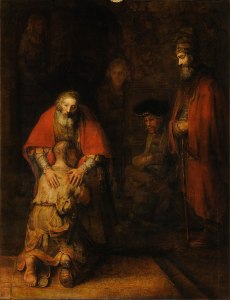
Credit: Rembrandt van Rijn. The Return of the Prodigal Son. c. 1668. Oil on canvas. State Hermitage Museum, St. Petersburg.