Who is healed when a story is told? In 2001, the physician and literary scholar Rita Charon published an essay in the Journal of the American Medical Association arguing that medicine required something she called “narrative competence”: “the ability to acknowledge, absorb, interpret, and act on the stories and plights of others.” Charon drew on the work of French literary theorist Gérard Genette, whose Narrative Discourse had shown how stories make meaning not through their content alone but through their structure. Their narrative. The detail a patient returns to again and again, even when it seems peripheral, is rarely peripheral. The patient who begins her illness story in childhood, or who jumps ahead to recovery, is making a choice, whether she knows it or not. “The narrative text, like every other text, has no other temporality than what it borrows, metonymically, from its own reading,” Genette wrote.
What Charon proposed was a practice of attention, a rendering of another’s life and suffering: to recognize it, metabolize it, be moved by it, and, after all that, act. A physician who could not attend to the structure of a patient’s story, its omissions, its repetitions, its choice of where to begin, was, to Charon, missing half the clinical encounter.
In the years since, her claim that narrative is foundational to health has moved beyond the bedside. Health communication, in particular, has taken it up, sharing Charon’s premises but working at a different scale. Narrative medicine asks the clinician to read one patient’s story closely. Health communication asks the researcher what stories can do across populations: how they persuade, how they travel, how they change what people decide to do with their own bodies.
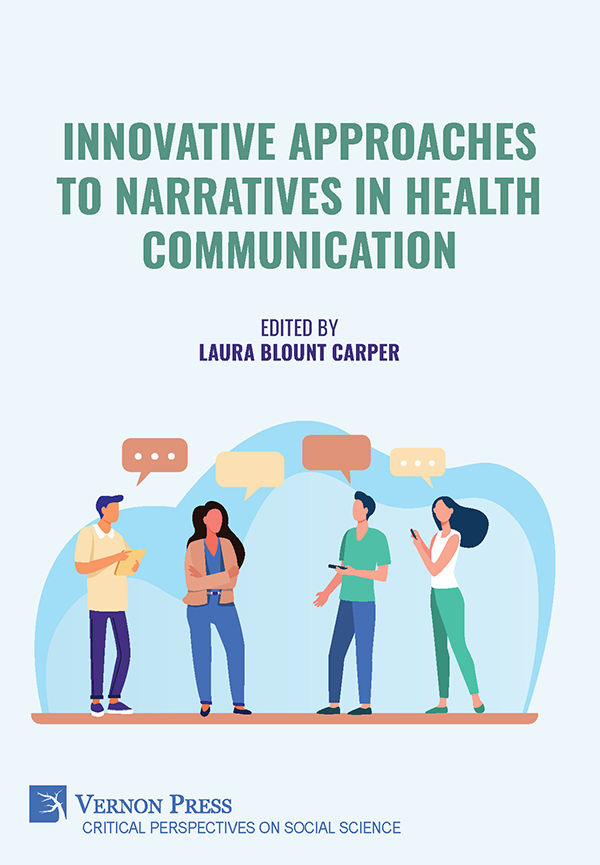
Innovative Approaches to Narratives in Health Communication (Vernon Press, 2025), edited by Laura Blount Carper of Texas A&M University-Texarkana, comes out of this second tradition. The collection studies narrative the way the social sciences study most things: as data. Narratives appear here as interview transcripts, survey responses, Facebook posts, expert panels. The question is whether what Charon understood as a clinician—that the form of telling shapes what gets heard—can survive being measured.
Carper’s introduction registers the central definitional question without quite answering it. What is “narrative”? She names four areas of narrative research—narrative as ontology, as epistemology, as individual construction, as relational process—but does not attempt to explore or resolve the tension that lies among them. Instead, she concedes that a deeper engagement with theory is “beyond the scope of these research chapters.” The reader is told, in effect, that “narrative” will mean different things in different chapters. Though this is honest, it is also consequential.
The collection’s strongest chapters are its most formally committed. Alyse Keller Johnson’s autoethnographic account of her mother Denise’s month-long ICU admission and death, titled “Your Mother Won’t Leave this Hospitalization,” is written in fragments, as if chronological coherence would falsify the experience. Reading through Charon’s concepts of attention and affiliation, Keller Johnson finds that the nurses and physicians caring for her mother were practicing narrative medicine without the name for it: addressing an unconscious patient by name, crying with the family, coming in on their days off. Equally strong is the chapter by Brann, Leverenz, Bute, Holman, and Kranstuber Horstman on reproductive loss, built around a composite narrative of a mother and daughter who have both miscarried, thirty years apart. They theorize story as empowerment, a way of reclaiming agency from a culture that frames perinatal loss as a “non-event.” Their evidence-based tip sheet for storytellers and storylisteners is among the book’s most practical contributions.
The more methodologically driven chapters treat narrative as a measurable variable. Comello, Francis, and Gray’s quantitative study of recreational video games among cancer survivors is rigorous, finding that the effects of game immersion on well-being depend on both narrative perception and whether the player identifies as a survivor. I found myself wanting more, though, about what a story inside a video game actually means to someone living with cancer (the experiential sense the regression models can only point at). Alison Novak’s discourse analysis of nearly thirty thousand Formula Finder Facebook posts during the 2022 infant-formula crisis is similarly thorough, with compelling findings about collective action in a crisis, though “narrative” here stretches to cover a exceedingly wide range of online speech acts. This is, I think, health communication’s great, recurring problem: the concept thins out, or spreads so wide it stops meaning much. Genette sought to specify what “narrative” is and to name its mechanisms—the ellipsis that marks what cannot be spoken, the repeated detail that signals what cannot be resolved. When the field abstracts away from that specificity, “narrative” starts doing the work of “communication,” and little is gained.
I was, perhaps, most drawn to McWhorter’s analysis of Black media expert panels during the COVID-19 vaccine rollout, which sets those panels within the long history of the Black press as a counternarrative institution. At a moment when public health is rediscovering the value of trusted, community-embedded messengers, and acknowledging that vaccine hesitancy in Black communities is rooted in real histories of medical mistreatment and ongoing inequity, McWhorter does more than analyze. She models what culturally grounded health communication looks like when it takes its audience’s history seriously. The final chapter, Kauer and Taladay-Carter’s cross-case analysis of health-care workers’ retrospective pandemic stories, lands on something telling: whether a frontline worker’s account bends toward redemption, ambivalence, or contamination correlates with how well they have made sense of what they have survived. Structure and meaning, inseparable again.
Carper’s collection is, at its best, a reminder that narratives are not simply about health. They are among the mechanisms through which health is made, sustained, and repaired. The book’s most compelling chapters recognize what Charon argued more than two decades ago: that attention to a story is itself a form of care. Yet they also extend her insight beyond the clinic, showing how narrative operates at the level of families, institutions, and communities.
Who, then, is healed when a story is told? Sometimes, the patient who finally finds language for their suffering. Sometimes, the clinician who learns to listen (to both others and themselves). And, sometimes, an entire community, whose ability to survive a crisis depends on whether its experiences and histories are heard. With this collection, we are shown that narrative is not merely a way of describing health. It is one of the conditions that makes health possible.
Works Cited
Carper, Laura Blount, editor. Innovative Approaches to Narratives in Health Communication. Vernon Press, 2025.
Charon, Rita. “Narrative Medicine: A Model for Empathy, Reflection, Profession, and Trust.” JAMA, vol. 286, no. 15, 2001.
Genette, Gérard. Narrative Discourse: An Essay in Method. Translated by Jane E. Lewin, Cornell University Press, 1980.