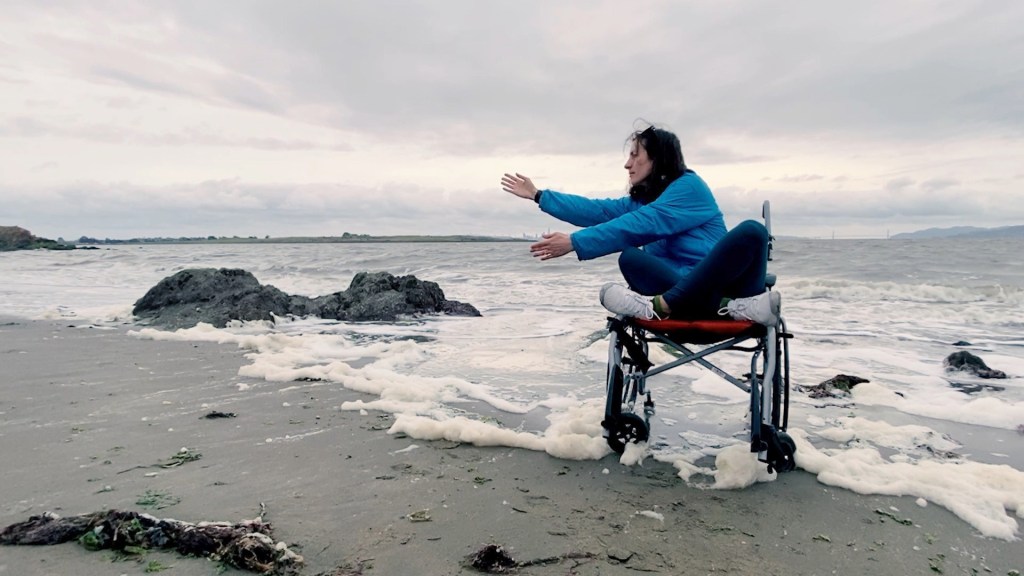
Photo: Karin, dancer in Unbound (2026). Courtesy of Unfixed Media / Sara Nesson, Director
The constructive friction between biography and curiosity is often fertile ground for critical inquiry. Lately, I’ve been considering the implications of analyzing dance in a health humanities context. It makes sense—I first trained as a dancer, and as one of the most embodied art forms, I think it’s fair to wonder what dance can teach us about the body, and what those lessons can tell us about health and care. Unbound, a short dance film created by individuals living with Myalgic Encephalomyelitis/Chronic Fatigue Syndrome (ME/CFS) and/or Long COVID, directed by Sara Nesson and produced by Kimberly Warner, offers an interesting touchpoint for health humanities inquiry.
Much of the health humanities scholarship in dance has to do with movement itself. Beyond the work of dance therapy—important as it is, I wouldn’t categorize it as health humanities study—there’s the sense that our approach to dance as health humanists might also be embodied. For instance, Aimie Purser’s work in the area avoids looking at dance as a cultural object: “dance can be conceived of within a Health Humanities framework both as a mode of (arts-based) healing and as a mode of (arts-based) knowing” (170). Perspectives like Purser’s are interesting and significant, yet I would argue that there remain aspects of viewing dance underexplored within health humanities inquiry.
It is significant that both Nesson and Warner are artists living with chronic illness. As a former dancer living with rheumatoid arthritis, I recognize a connection between physical movement and narrative from my own experiences, and draw on those to illuminate critical insights. In this way, I suggest we use a narrative medicine framework, where we study texts—in this case choreography and performed movement—to recognize, absorb, interpret, and act on the stories told through dance: “Dance’s social dimension reflects and influences social organizational structures, as well as relationships among individuals within a group and between groups” (Moraru and Pop 366). We quickly understand that by watching Unbound that close viewing allows us to take in the stories of living with Long COVID and ME/CFS.
Inherent to the project of Unbound is an argument that a group of dancers—often referred to as a company—and a group of patients suffering from the same disease (or closely related diseases) can be studied similarly through an anthropological lens. According to Moraru and Pop, “Dance functions both as a tool and a vector for promoting cultural values, significantly impacting the preservation and affirmation of identity” (366). Through the editing of the film, Unbound stitches together segments of solo dancers, enacting a bodily language that approximates the experience of living with Long COVID and ME/CFS. The film affirms individual identities, while also providing space for a specific, communal identity. As we watch, we come to comprehend that the dance enacts both the stories of each dancer, and also this company of dancers, now threaded together through film.
It is important to acknowledge the spaces where dancing occurs. Each dancer is located in a physically separate location. Some are intimate domestic spaces, rooms within homes and outdoor spaces like decks and patios. Throughout, there is a natural element, with the the soundtrack beginning with birdsong. Several of the dancers are seaside, dancing beside red rock and water. These can all be read as protective and healing spaces. The varying locales reinforce that this community is wide-ranging, held together by something more than shared place. The spaces preserve the sense of individual identity even as the dance makes the connective and communal ties apparent. Moraru and Pop describe this “dualism—similarity versus difference—form[ing] the foundation of the concept of identity, which is not homogeneous but comprises interconnected, continuously evolving elements” (366). Place serves to identify individual dancers as well as the group dynamic.
Similarly, movement itself emphasizes these dual individual and communal identities. Some dancers are seated in chairs or wheelchairs, while others use their entire bodies to perform. Their arm movements are particularly vivid, specifically the use of the hands, which gesture in a variety of ways but often incorporate upturned palms, offering a sense of openness, receptivity, and, at times, a pervading sense of grace that becomes a common theme. It is a stark reminder that a person living with disease continually relearns the value and importance of treating their self with grace. The simple gesture of a dancer hugging her own body took on a poignant significance in Unbound, the surest sign of self-acceptance.
While many dancers showed evidence, in their movement, of prior dance training, it was clearly not a prerequisite, and some of the most moving segments included people without formal training. In these moments, those dancers felt out those movements that expressed their experiences. One man moved wavelike across a patch of grass shaded by trees, a gesture that, as it was repeated, reminded me of echoes, the residue of a bigger emotional event, a fading trace of something that had already happened. Gestures of hands around the face were also particularly moving, revealing an anguish that’s difficult to put into words yet remains evocative on film.
There are places where the dancers seem to hand off their segment to the next dancer, and this editing reinforces the idea that we are watching a community of dancers. I don’t know if they thought of themselves as a company, but I could not help but connect the idea to the corps de ballet, literally the body of ballet.
In Unbound, we bear witness to what Purser describes as “the location of human subjectivity in the flesh of the human body rather than in an ethereal mind . . . significant because it allows a non-dualist sense of self where human bodily-being is simultaneously both objecthood and subjecthood” (168). As I watch the graceful movement of arms, I cannot help but notice how often the dancers avoid looking towards the camera, as if to suggest that we may watch but the stage is not chiefly designed for our viewing. Perhaps the dancers are reclaiming their first-person point-of-view, rather than the traditionally accepted gaze of the proscenium stage.
If, “dance represents a space where meaning is constructed through movement, ideas are materialized, and questions about self, culture, and the world are explored” (Moraru and Pop 367), then, Unbound makes a specific and crucial statement about reclamation of chronic illness and the disabled body. The film was specifically created with the Exquisite Corpse in mind, a collaborative parlor game developed by surrealists in the 1920s. Also known as cadavre exquis it is a method of production where each participant takes a turn writing words or drawing sections of a body on a folded sheet of paper, hiding their contributions so the next contributor can only see the very end of the previous work. In Unbound, this is accomplished by echoed gestural movement, the effect being cohesive while maintaining a sense of improvisation. As assemblage, one cannot miss the metaphorical implications. Movement is used to evoke a body (singular and collective) that is haunted, possessed, or simply different from how it used to be experienced. Chronic illness often means living inside a body that doesn’t behave predictably, and the exquisite corpse plays with a notion that such a body is fragmented yet connected, mirroring the discontinuity of embodied experience over time. It is a powerful way to externalize what illness feels like from the inside.
Watching a film like Unbound, what does one learn about the body? Ideas of constraint and restraint are tested, ultimately a way of enacting and not restricting creativity. It’s important to note that Unbound presents estrangement with virtuosity, agency, even humor, so the body reads as strange and fully authored. It is not simply strange because it’s been taken over by illness. One also learns about the body as both individual and communal—different forms, by dancers of varying ages and races, yet the accretion of gestures and movement across bodies tells us something vital about the state of dancing by disabled and chronically ill persons. One might even call it a kind of charting that extends beyond the specificity of a disease. It is not clinical record, but it is a record of a body that refuses to be bound by circumstance. It is a body that communicates, and one that is unshackled from time and space. Dancers perform alone, together, in their specific space and across spaces, and, as the title itself suggests, unbound from such constraints.
Bringing it back to my own experience: as a former dancer living with rheumatoid arthritis, I was moved by what I saw, because I have never used my own body or training to express that experience. Watching how these dancers revealed their lived experience read to me as expression beyond narrative, and rather than adhering to a specific plot, they made an internal state external through movement. Unlike my own experience, in which my identities as dancer and as someone living with illness have always felt split apart, these dancers showed that their identities as both dancers and people living with ME/CFS and/or Long COVID were not cleaved. In this way, the critical and the personal integrated exposed a crucial insight. The dance itself evoked what many patients, fractured by illness, yearn for: wholeness.
Author’s note: Having had the chance to view this dance film pre-premiere, I would like to thank Sara Nesson and Kimberly Warner for advance access.
The world premiere of Unbound is July 29, 2026, at 6:30 PM (ET), and information about viewing the film can be found at https://unfixedmedia.com/unbound.
Works Cited
Moraru, Cristina Elena, and Alina Elena Pop. “The Anthropology of Dance from the Perspectives of Culture and Motricity.” Sport & Society / Sport Si Societate, vol. 25, no. 1, Jan. 2025, pp. 364–72. EBSCOhost, research.ebsco.com/plink/46d1a9a2-685a-33e2-94bb-9ae280ffbe8c.
Nesson, Sara, director. Unbound. Produced by Kimberly Warner, Unfixed Media, 2026.
Purser, Aimie. “Movement as Method: Some Existential and Epistemological Reflections on Dance in the Health Humanities.” Journal of Medical Humanities, vol. 42, no. 1, Mar. 2021, pp. 165–78. EBSCOhost, https://doi.org/10.1007/s10912-021-09679-1.