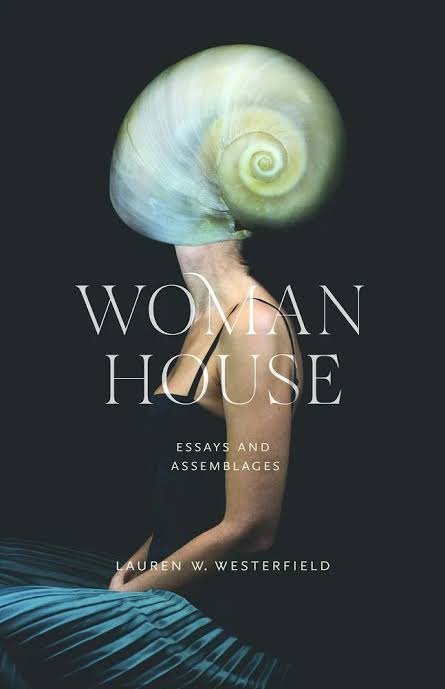
Accompanying her mother for her ECT treatment at Providence Sacred Heart Medical Center in Spokane, Washington, Lauren W. Westerfield devours Jean Frémon’s Now, Now, Louison over two consecutive nights. Frémon’s book, as he states and Westerfield herself echoes, is a “portrait in motion.” Rather than a crude biography, it is composed as the inner dialogue of the late artist Louise Bourgeois, taking the reader from one memory to another in fragments and walking them through the artist’s life, art, and familial relations, much like Westerfield’s own book, which draws its title from Bourgeois’ renowned series Femme Maison (Woman House).
Westerfield’s self-portrait is also in motion. Although the general sequence of the narrative—from hearing at age 27 from her mother that she was assaulted around the same age to the isolating days of COVID—remains linear, many memories are woven into and bend that linearity as she recalls her parents’ turbulent relationship, her struggle to accept her own body, sexuality, and desires, alcoholism, and, more than anything, her relationship with her mother, which gives us a portrait of care in motion.

Wikiart (Fair Use)
In her analysis of Bourgeois’ Femme Maison, Katharina Eck highlights a complexity that illustrates “interference and simultaneity of visibility and invisibility, fear and everyday life, hiding away and being kept enclosed—and also as accepting a social role (that of a housewife in this context) and as rebelling against it.” Bourgeois’s imagery from 1946-1947 features women’s bodies combined with houses. However, it remains unclear who/what lodges in what/who. On the one hand, houses seem to capture women’s bodies, almost to keep them in order and captive; on the other hand, there is an unstoppable extension that cannot be contained by the contours of a house, that is, domesticity and family. This tension also marks Westerfield’s book as she tries to figure out who she is as a woman and a writer while navigating her social roles as a woman and as a daughter, neither of which is inseparable from who she is (becoming).
Westerfield is drawn to how Bourgeois depicts this imagery: “a woman who hides” (46). At the same time, this is a woman who thinks and acts. There is an overt disproportion in the drawings, something absurd, yet amid all this, you cannot unsee the movement of hands and legs, the vitality. It is impossible to unsee how this imagery reflects Westerfeld’s self-portrait. As she grows up, her mother prevents her from accessing anything that might contain sex and violence (TV shows like Friends). Later, she connects this to her assault, seeing it as a revelation of vulnerability disguised as perpetual control. Yet she points out that there were many times her parents missed the misogyny and violence, seeing it instead as a sign of the class and culture they grew up in, like those 30s-40s classic Hollywood films.
Of Femme Maison, Westerfield writes that she found herself “curious, drawn in by the peculiarity and independence of [Bourgeois’s] strokes, her bodily awareness, her iterative attention to the little oddities…: our animality, our life” (4). The book unfolds as a discovery of the agency of her own body (how she moves, how she is seen and sexualized even before she has a conscious understanding of it, how she can and cannot walk away from things), and of the fragility of her mother’s body and ego. Westerfield has been caring for her mother during a series of surgeries and cancer treatment, especially after becoming the primary caregiver following years of her parents’ separation. She lodges in the house of care that suspends her, yet, as the book shows, in a way, that cracks her open.

Wikiart (Fair Use)
It is not surprising that the first essay in the book opens in a hospital (the image of the body in a building). Westerfield walks into the ECT waiting area. Electroconvulsive therapy is a medically induced seizure produced by small electric currents passing through the brain for less than a minute. Still controversial because of side effects, including short-term memory loss, it is used to treat severe depression, as in Westerfield’s mother. This memory from 2019 offers a glimpse of the landscape of healthcare at the time and our reflexes toward cure and care. While seeking treatment ranging from plastic surgery to Zumba has become almost a lifestyle for her mother, Westerfield seeks knowledge and trust to be on board with care. After a long period of research and concern, it takes only trust in a doctor for her to be convinced that her mother can go through with the treatment. In a recent podcast on the New Books Network, Westerfield mentions that, given recent research on ECT showing more severe side effects, it is scary to look back on everything retrospectively. It is also telling that, although her mother underwent the procedure again, not long ago, the results were much weaker this time, which, in a way, speaks to the question of progress and how it is mistaken to assume betterment as ‘science advances.’
Although care is central to the book, it is not extensively a subject of discussion. There are three direct references to care that are worth mentioning here. At the time of her surgery to correct a rectal prolapse, which later caused her “almost death,” Westerfield’s mother warns her daughter and then her husband that “I don’t think either of you understands what this is going to be like, taking care of me, taking care of the house” (93). Entangled with Femme Maison, this sentence strikes a nerve with the reader. Not only does the body, in its labor and caring, become equal to the house, but one’s collapse possibly brings the other’s demise – this imagery is almost a darker variation of Femme Maison, with the complete enmeshment of the woman’s body and the house. In an earlier essay, Westerfield talks about forgiveness as an act of care that involves “see[ing] humanity in oneself and others, to care for both with equal generosity” (58). Throughout the essays in the book, so many times Westerfield repeatedly looks at herself (both literally in the mirror but also by visiting her memories) and her mother, especially watching her body go through ECT, chemo, and colonoscopy. In all of these moments, something about both images, their givenness – her as a daughter always following orders and doing the right thing, and she as a controlling and dramatizing mother – becomes distorted, only to be extended into “multitudinous” images and stories.
This brings us to self-care, which is mentioned only once, when self-isolated during COVID: how to take care of the self, meaning how to be productive, improve yourself, and so on. “The lines between health and self-care, between power and adherence to the patriarchy,” writes Westerfield, “are not only fused, but they are also inextricable from our identity codes” (135). Although there is almost a hint of guilt in self-care, a fear of being complicit in patriarchy, the book, as an artistic reflection, becomes an act of self-care for Westerfield, an act of forgiveness in the sense of recognizing the humanity and thus the fragility of her own and her mother’s. And her very own Femme Maison, with responsibilities, nakedness, suspension, and stretching. It hides, and it reveals.
Works Cited:
Eck, Katharina. “Protective Buildings, Exposed Bodies–The Femme Maison-Imagery in the Art of Louise Bourgeois.” Women’s Studies, 41(8), 904–924, 2012.
Frémon, Jean. Now, Now, Louison. Translated by Cole Swensen, New Directions, 2019.
Westerfield, Lauren W. Woman House: Essays and Assemblages, University of Massachusetts Press, 2026.
Westerfield, Lauren. “Woman House.” New Books in Women’s History, Hosted by University of Massachusetts Press Staff. New Books Network, May 29, 2026. https://newbooksnetwork.com/woman-house