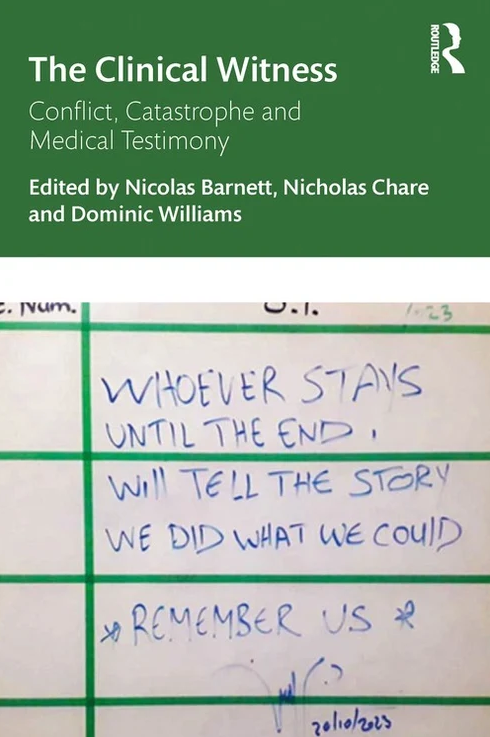
Nicolas Barnett, Nicholas Chare, and Dominic Williams, eds. The Clinical Witness: Conflict, Catastrophe and Medical Testimony. London and New York: Routledge, 2026. 291 pp. Paperback, DOI 10.4324/9781032668369
–
A tragedy will unfold in 2027. We can take our pick. Say there’s a hurricane in a place that never used to get hurricanes. There’s a shooting spree. A pandemic. A genocide. A war. Another one. The eyes of the world – at least insofar as a “world” is constituted by the hyper-networked digital surveillance system we call the internet, we call Facebook or Instagram, we call news media – will turn to witness. Journalists will deliver solemn-faced reports from the ground. We will see flickering shots of fires, or explosions, or screaming children, weeping mothers. We will read the first-hand (or second-hand, or third-hand, or millionth-hand) accounts of the survivors. We will look and we will feel that we have seen, even through many degrees of removal, and perhaps we will share it, speak on it, so that others can look, too. So that we can all bear witness.
Some of those who witness will be physicians, nurses, forensic experts, medics, and humanitarian aid workers. In their recent collection titled The Clinical Witness, editors Nicolas Barnett, Nicholas Chare (who also provides translations for numerous chapters), and Dominic Williams argue that the witnessing of clinical and healthcare professionals differs qualitatively from the witnessing of others. This initially self-evident claim (personally, my interest is rarely piqued by a straightforward claim of difference) develops dimension, complexity, and import through the interventions of the collection’s eighteen additional contributors, who represent a broad range of experiences in the healthcare professions, medical humanities, anthropology, history, public health, and forensics, among others. While many of the contributors draw on the intellectual lineages of Amer-European (primarily American, English, and French) thinkers, the contributors and their case studies make for a robustly international collection.
Organized first chronologically for two sections and then topically for three, each contribution responds in its own way to the framing questions of the collection: How do the testimonies of clinical witnesses differ qualitatively from those of lay witnesses? In what circumstances are clinical professionals impelled to bear witness? What forces collude to enforce their silence? In what ways have clinical professionals been culpable (both materially and ideologically) in the very horrors which we might feel they are ethically obligated to reveal?
Drawing on the work of the psychiatrist Robert Jay Lifton (who is known for his work studying the psychological effects of the atomic bombing of Hiroshima), the editors offer a provisional set of answers. The “witnessing professional” (Lifton’s term) is bound by an ethical duty to bear witness to the “malignant normality” of the world, or the “set of actions and assumptions that outwardly appear normal but are actually dangerous and destructive” (11). The editors also read Lifton as emphasizing a shift “from the micro- to the macro-view” (11) of human suffering, wherein the witnessing professional’s “act of witnessing . . .surpasses each individual history” to produce instead “a statement that encompasses not just the human but humanity itself” (11). They read Lifton as making a claim on the ethical responsibility of the witnessing professional to speak out about what they witness, “to take a position in relation to acts of injustice and (physical or structural) violence” (11), particularly because the witnessing professional may be in possession of “skills of communication that render them particular adept at sharing their experiences and perspectives regarding a given event” (12). The witnessing of the clinical professional, then, “involves attesting to both the facts and ‘a truth about humanity and suffering that transcends those facts’” (Oliver, qtd. in Barnett et al. 12).
Lifton’s benevolent view of clinical witnessing is both upheld and challenged at different turns in the collection. Derek Summerfield’s chapter, for instance, charts the stomach-turning history of physician complicity in state torture practices. With his usual eloquence, Didier Fassin traces the etymology of the word “witness” in various languages to illustrate how different cultural-linguistic understandings of what witnessing entails may risk drawing equivalencies between suffering that is the result of asymmetrical relations of power (ie, in the case of the conflict between Israel and Palestine).
Other contributors chart the ways in which clinical professionals’ attempts to speak out have been either silenced or subdued by larger forces and politics. Dominic Williams and Monika Rice, for instance, both write on the “choiceless choice” faced by prisoner-doctors within Nazi concentration camps, who were often forced into participating in the murders of their own fellow-inmates under threat of death themselves. Junko Kiriya and Taeko Kiriya examine how Japanese doctors studying outcomes for the survivors of the atomic bombs (hibakusha) were silenced by the US moratorium on that very research and reporting.
Bearing witness [is] also a means of paying homage and fulfilling a responsibility to those who were murdered, to ensure that these events would go down in history, that they would not be forgotten. (Rylko Bauer, “Bearing Witness to Inhumanity”, 55)
The scholarly work that composes much of this collection will find a readership with the health humanities broadly. However, as one reader, my interest was particularly arrested by those contributors who wrote on their own experiences providing healthcare, forensic analysis and burial, and other forms of humanitarian aid. These writers contribute their own testimony as itself a critique of their roles as witnesses to human suffering. Of particular note is Shari Eppel’s chapter, which analyses her experiences with the forensic exhumation and reburial of the victims of the Gukurahundi massacres in Zimbabwe between 1983 and 1987. The collaboration she experienced with the victims’ families, many of whom had never even dared to speak of their lost loved ones, challenges the image of the solo clinician giving testimony on a witnessed atrocity. Instead, Eppel invites us to see witnessing as a practice that emerges between a clinical professional, the bereaved community, the wronged ancestors, and the very bones of the dead.
Both the most incisive and the most nuanced exploration of the quality of clinical witness comes in the final contribution to the collection (excepting Barnett’s coda) from Hans Husum, a Norwegian trauma surgeon with over forty years of experience in wartime theaters. Husum’s contribution departs from the linear academic prose that characterizes much of the rest of the collection; instead Husum lurches across recollections of his time treating the wounded of violent conflicts in such countries as Iraq, Afghanistan, and Myanmar (Burma). Husum’s chapter (“The Nausea”) reflects Eppel’s entangling of the wounded and the witness in a more somatic key. Meditating on both the clinical distance and visceral intimacy that surgery demands, he writes:
. . . you must be inside the wound to be able to understand it, to read it, to care properly for it. The hand is an extension of the brain, let it feel all the broken cells, let his fluids run between my fingers. The outside is dangerous. When the skin, the interface between Me and Them, fractures, it renders the inside unsafe too. The sickening smell stuck to me. I wanted to scrub my own skin off but didn’t – people might think I’d gone crazy. There are no words for this nausea. (254-255)
Other contributors working from a more psychiatric framework might describe Husum’s troubled psyche and recurring bouts of nausea as post-traumatic effects of primary and secondary survivorship. But Husum’s description of his hand delving through the wounded body of another, the fracturing of the skin in the name of healing that obliviates the boundary between Self and Other, suggests a weave of hurt and healing that, to my eye, eclipses what most conventional theories of trauma can offer.
This, then, is perhaps what the clinical witness names with their testimony that other testimonies cannot quite capture. The testimony of the aid worker, the surgeon, the physician, the nurse, and that of other frontline responders lies not in the words they speak to cameras or dedicate on the pages of autobiographies, or at least, not only there. The clinical practice itself – hands treating wounds, plunging through hemorrhaging organs, turning over the soil of mass graves, or conversely, treating patients between rounds of torture or writing the diagnosis that will send them to the gas chambers – becomes its own form of witness, one which annihilates the boundary between the survivor and the witness, the subject and the object, the act of violence and its recollection.
In the case of ongoing crises like that unfolding in Gaza, Barnett suggests in his coda that we are at a “degree zero of witnessing” (277, emphasis original), or as Roland Barthes might describe it, “the point where all meaning is extinguished and yet all meaning paradoxically emerges” (277). The next pandemic, the next genocide, the next war – how are we meant to live through our witnessing of such horrors? What meaning ought those of us in medicine or the medical humanities make from violence that annihilates meaning’s very possibility? How should we respond to the scream of the wounded, “a scream that is almost deafening in its silence and one that quite literally exudes existential (dis)quiet” (277)? This collection offers no easy answers, but it makes a compelling argument for the value in naming the differential ways in which we witness and give voice to that suffering.
Our central task as the inheritors of these testimonies is not to ask what role they have played historically but what role we can make them play now. How do we, the next and future generations, make use of these witness accounts? (Kiriya and Kiriya, “Role of Medical Records Regarding Atomic Bombing Experience”, 99)