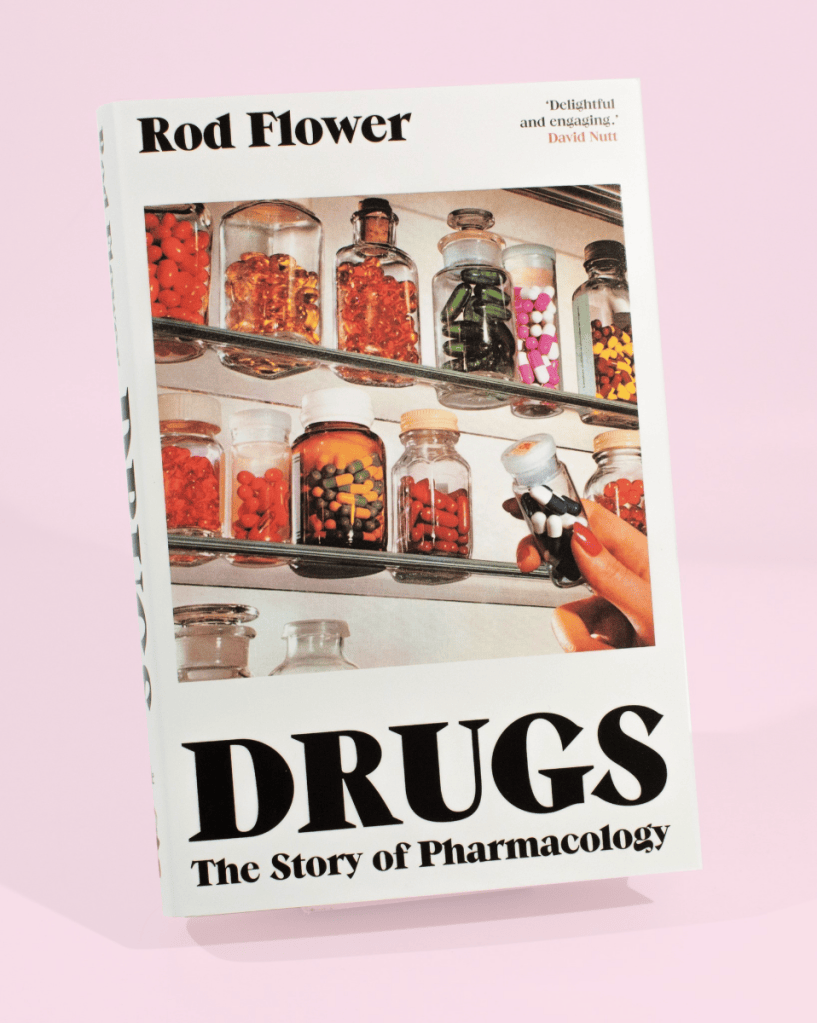
In his new book Drugs: The Story of Pharmacology (Yale University Press, 2026), Rod Flower, Emeritus Professor of Biochemical Pharmacology at Queen Mary University of London, offers a grand-sweeping account of how humans have come to know and use medicines as we do in the present day. Throughout the book’s twenty-two chapters, Flower guides the reader through 50,000 years of human medicinal and medical history, through to the golden age of pharmacology, beginning in the mid-nineteenth century.
Chapters two through four set us off on this wide-sweeping historical journey. Covering an impressive amount of ground in a short section, this portion of the book offers a pharmacologically minded counterpart to Henry E. Sigerist’s “The History of Dietetics”; moving swiftly from Neanderthal remains found in El Sidrón, to the historical importance of the Ebers papyrus (dating back 1500 BCE), onto the lasting impact of the Greco-Roman tradition through figures such as Hippocrates, Aristotle, and Galen, and their preservation in Avicenna’s canon (to name a very select few!), Flower competently bridges the Ancient and the Modern, and ties it neatly in a bow in his chapter “Untethered From the Ancient Past”. Drawing out how liminal the early modern period was for medical history, Flower successfully highlights historical moments in which erroneous and often self-fulfilling hypotheses (such as the ‘doctrine of signatures’) were corrected through the implementation and use of the scientific method.
Getting into the nitty-gritty of how drugs work, chapters five and six offer a sort of boot camp for the technically unfamiliar, without which, the rest of the book would be inaccessible to the layperson. Easing the reader into these more technical spaces, Flower does a good job of introducing the principles of cell biology and the molecular shape of drugs by interspersing it with anecdotes to offer color, and helpful graphs to illustrate these more complex visualizations. With this new knowledge, Flower carries on by guiding the reader through mid-nineteenth- and early twentieth-century advances in understanding the complexities of drug administration and absorption, the discovery of the nervous system, and the increasingly intimate relationship between pharmacologists and cell receptors.
Later turning the problem on its head, Flower introduces the concept of pharmacokinetics, or the study of what bodies themselves do to drugs throughout the process of absorption, distribution, metabolism, and excretion. Understanding the multiple, yet expected, ways bioavailabilities and genes interact with pharmaceuticals has, since the 1920s, turned pharmacology into “a science that endeavours to ask two questions: firstly, what the drug does to the body, and secondly what the body does to the drug” (157). It is with this primer that Flower continues on, tackling issues such as the dangers of drug interactions and side effects in subsequent chapters, masterfully cushioning his explanations with anecdotes of reading leaflets and erroneous headlines from the early 2000s, in an effort to relate these concepts to experiences and moments most, if not all, readers can relate to.
In the latter half of the book, Flower deals with a number of causes célèbres of pharmacology—first touching on the difficulties of drug testing in humans, and how (until recent years) lack of consideration for biological variability at the trial stage made it difficult to allocate the appropriate medicines to a patient according to their genetic makeup, as well as the effects we know these drugs to have in controlled environments. Followed by a foray into the complexities of treating infectious diseases, Flower outlines how the development of anti-infectives, antibiotics, and antiviral drugs have prevented catastrophic human losses that even pasteurization, vaccination, and sanitation improvements could not prevent. Moving on to the pharmaceutical industry itself in the next chapter only further emphasizes this previous point, where he notes that “prior to the the Second World War, the pharmacopoeia was ‘a bag of blanks’, and it is the […] industry that has turned this situation around and is, in large part, responsible for the revolution in medicine that has taken place during the last 100 years.” (234) Despite their life-altering benefits, medicines produced by “Big Pharma” groups remain out of reach to most of the world’s population. For this remaining near-80% still without access, Flower outlines how plant-derived medicines have continued to be a mainstay with proven-yet-limited efficacy, providing some well-chosen examples such as colchicine, ephedrine, and quinine.
In a final thematic break, Flower moves toward the power of psychoactive drugs, and the line they blur between medicine and recreation, signalling an overture to the future of therapeutics and the directions in which he anticipates the field to be heading. A similar optimism is reserved for his treatment of placebos, and the opportunities they provide to study the interaction between the mind and the body. In “Playing God”, Flower reminisces on the pharmacological advances of the last two decades, and how they have presaged the current landscape of the field presently “occupied by working out the potential for developing new drugs afforded by molecular biology and the opportunities for intelligent data gathering and sophisticated analysis offered by AI” (291). It is with much more enthusiasm that he mentions the prospects that molecular editing tool CRISPR could offer by way of treatment for genetic disorders.
Flower’s comprehensive overview of the history of pharmacology is impressively rigorous—it does not underestimate its reader, and proves a thoroughly informative read for any interested in the processes through which we have attained modern medicine, pharmaceuticals, and chemical treatments. Drugs reads fairly smoothly, with its short chapters, and even shorter sub-sections lending themselves well to putting it down and picking it back up. I appreciate Flower’s aversion to dumbing down the material— though it was occasionally heady, and more textbook-esque, than storylike. This, of course, could be derived from the fact that its principal actors shift from people to cells, molecules, organs, nerves, and receptors: a rather unusual cast for a history book. Ultimately, Drugs left me with an overwhelming appreciation of the incredible machines that are our bodies, the complexity of the innumerable chemical reactions occurring within them every single day, and a profound admiration for those who have devoted their careers, and lives to improving the quality of ours.
Works Cited