Side note: The reviewer of this book is a poet and playwright with a Ph.D. in Theatre Studies, and was diagnosed with borderline personality disorder in 2018. Her review will conform to academic standards. Her reading was situated at this very intersection of selves.
“It felt like we were at the end of a thousand-piece puzzle.”[1]
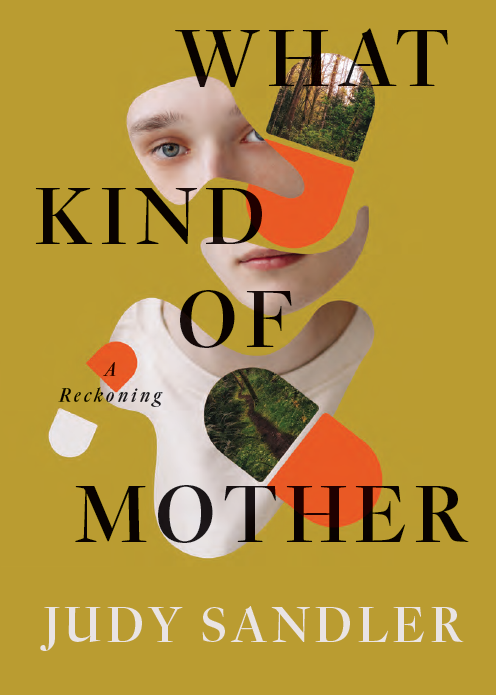
In her nonfiction debut What Kind of Mother, Judy Sandler presents a non-chronological autobiography composed of scattered fragments—which the book cover’s graphic design subtly hints at. In fact, the puzzle is a fitting concept for this book, and serves as a clever metaphor for any retrospective inner quest: when caught up in the relentless whirlwind of life, it is impossible to see the big picture we are putting together event by event, choice by choice, piece by piece. And in the end, when we finally step back to observe it, we notice that some pieces are missing, and we never experience a sense of complete peace. And— this is what I’ll take away from this book—maybe that’s okay.
“I trust you to tell your story and not mine.”[2]
Addiction issues, mental illness, attempts at recovery, progress, setbacks: a mother tries to make sense of her son’s troubled life journey in light of her own history. Without sentimentality and from an unvarnished self-oriented perspective, she allows herself to explore how her son’s type II bipolar disorder has affected not only his life, but hers as well. By drawing parallels between key moments in her son’s life and her own (with particular emphasis on the avoidance of conflict, which has shaped the family over several generations), she sheds light on the choices she has made in order to achieve, if not inner peace, then at least a sense of integrity. But at no point does she tell her son’s story for him, even when she includes (with his permission) excerpts from his diaries — in line with her late acceptance that she won’t be able to save him from himself. This stance is complex and difficult to maintain: it is that of the caregiver, whose voice is rarely heard. What Kind of Mother is a very honest account of that role and the intertwined emotions — love, discouragement, anger, guilt — that come with it.
“What kind of mother doesn’t allow a child in need to return home? What kind of mother refuses to offer shelter and a cup of coffee to a son who has no place to go? This mother.”[3]
Devoid of any self-indulgence, the narration captivates with its disarming openness; its humble laying bare of memories. Judy Sandler hides nothing regarding past thoughts, feelings and events, even when her own role in them now seems questionable to her. Better yet, she anticipates the possible reactions of readers who might judge her too hastily (i.e. with the benefit of hindsight) by including several timely sections wittily titled “I’m Glad You Asked”. Thus, Judy Sandler comes across as someone who has already given her subject a great deal of thought; someone, in fact, whose portions of their work have already appeared in previous publications; someone who writes only once her voice as a reflective narrator has been firmly established, freed from the raw emotions of a mother. That is how she is able to address many issues raised by mental illness; notably the complex question of how the social norm draws a line between a “delusional”[4] person and a “sane”[5] person, which means that psychiatric diagnosis—and the consequent need for treatment—are inevitably embedded in a cultural context, while still being subject to a private assessment by the person in question and their loved ones.
“I didn’t mean to write a book.”[6]
The text is, quite pleasantly, structured into very small units, shorter than standard chapters (some are barely a page long). Each unit is circumscribed and coherent, with a clear beginning and end, and captures a precise moment or train of thought. This surprising format may stem from the fact that the author had already written a few short pieces on the subject, which she later incorporated into her book project. Be that as it may, this original structure, which borders on prose poetry, is undoubtedly one of the book’s strengths. Another enjoyable aspect of the book’s structure is its non-chronological approach. The narrator takes us quite smoothly back and forth between years that echo one another (her childhood and her son’s, her admission to college and her son’s…), which allows her to shift the focus away from mental illness and engage in a broader reflection on harmful transgenerational dynamics. This discontinuity sometimes leads the author to recount the same events a few times. But this apparent redundancy might well be part of the book’s very approach, which consists of breaking free from memories that have taken the form of traumatic loops. However, Judy Sandler drops this temporal palimpsest in favour of a more traditional structure in the final third of the memoir, which corresponds to the poignant and unresolved conclusion of his son’s journey—and of her own’s, in the form of a letting go. As for the book’s writing, it is very accessible and engaging. The narrative moves along effectively and the style is fluid; fairly straightforward, perhaps a bit plain, with some beautiful bursts of literary expression—an unexpected trait in a nonfiction work.
“This felt like a time of answers.”[7]
What Kind of Mother is compelling. The 350 pages or so of this gripping journey fly by—not a journey, as they say, into the inner workings of the mind, but precisely from that powerless vantage point, outside of it, which makes it all the more heartbreaking. It is as addictive as a diary, offering the guilty pleasure of peeking into someone’s private life. It is as thought-provoking as an autobiography, leading you to wonder what your place is within your own family and what the turning points in your life have been. It is as tense as a thriller, having you worry about the fate of each of its endearing characters. And it is as painful as a family drama, with heart-wrenching scenes that will tie your stomach in knots. Readers of all backgrounds and habits will find this book appealing thanks to its (once again) highly attractive structure and, above all, because of the universal and crucial question it addresses: How to love somebody who is suffering and who, without meaning to, causes you to suffer?
“Let it be a beginning, okay?”[8]
Side note: Reading this excellent book was emotionally taxing, though that experience was softened by the author’s ever subtle approach. It captures the immense exhaustion (and immense dedication) involved in caring for someone whose invisible struggles spill over into the lives of others. And when you were diagnosed with a mental health disorder, that someone is you.
[1] Judy Sandler, What Kind of Mother, West Virginia University Press, 2026, p. 301.
[2] Ibid., p. xiii.
[3] Ibid., p. 327.
[4] Ibid., p. 238.
[5] Ibid.
[6] Ibid., p. 333.
[7] Ibid., p. 313.
[8] Ibid., p. 332.
Cover picture courtesy of West Virginia University Press.