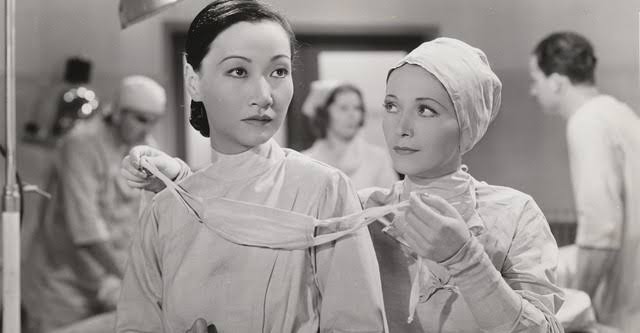
After a long and difficult operation, a perioperative nurse removes the attending surgeon’s mask, dramatically revealing the composed, authoritative face of Anna May Wong. In Nick Grinde’s proto-noir B-movie King of Chinatown (1939), Wong plays Dr. Mary Ling, a character inspired by Margaret Chung, the first Chinese American female doctor and a prominent fund raiser for China during the Sino-Japanese war.[i] Produced at a significantly lower budget than the prestige A-list pictures, B movies afforded a space to explore marginalized subjects and politically inflected content. King of Chinatown makes full use of this latitude, positioning a Chinese American woman as a figure of medical authority and deftly navigating questions of race, assimilation, and transnationalism on the eve of World War II. In so doing, the film reimagines medicine as a space in which competing visions of modernity and care are negotiated.
The film emerges at a pivotal moment in Wong’s career. After being turned down for the lead role in The Good Earth (1937) and infuriated by the roles Hollywood offered her, Wong journeyed to China where she made her own documentary My China Film.[ii] Freshly empowered by her travels in China and armed with a new three-year contract with Paramount, Wong returned to Hollywood eager to make films in which Asian Americans had “sympathetic parts for a change” (Wang 141; Huang 258). Wong brought to King of Chinatown an intensity that belied its B-movie status. In preparation for the role, she observed a kidney operation at Los Angeles Hospital and collaborated with the legendary costume designer Edith Head to craft an image of a Chinese American professional woman, shaped less by Hollywood Orientalism than by Wong’s own cosmopolitanism, informed by recent travels through Europe and China (Click 8–9).[iii] The project was of personal and political importance to Wong, and much like her character Mary Ling, she actively supported the Chinese war effort against Japan—auctioning off her gowns, appearing at relief events, and hosting a One Bowl of Rice fundraiser in San Francisco (Wang 46-47). In this capacity, King of Chinatown exceeds its genre picture status, marking the convergence of Wong’s star power and her wartime activism.
Wong’s extra-filmic commitments are translated into the film narrative itself, where medicine serves as the privileged modernist site of transnationalism. This is perhaps most clearly exemplified in the extended dinner sequence that follows Ling’s successful operation at the hospital. Mary hosts nurse Dolly Warren (Bernadene Hayes) and her ambulance driver boyfriend Rip Harrigan (Roscoe Karns) for a Chinese New Year dinner celebration prepared by her father, Dr. Chang Ling (Sidney Toler). Late for dinner, the company arrives in an ambulance, siren blaring—an entrance pointedly contrasting the Bay Hospital’s approach with the quiet continuity of Chang Ling’s medical practice.
Inside the Ling home, another epistemology holds sway. Mary’s greeting, “Hello, Dad. Happy New Year!” is quickly intercepted by her father, who reminds her how he supported her becoming a “modern up-to-date doctor” and “countenanced” her working in a hospital. He even concedes that “if” some of his “herbs had proven unsuccessful” he might have sent one of his patients to her, but insists, “Please, do not say ‘Hello, Dad!’” While Chang acknowledges the legitimacy of Western medicine as practiced by his daughter, his conditional hints at a prior authority of traditional Chinese medicine. Indeed, surgery is presented as recourse rather than replacement. Acceding to her biculturalism, Mary apologizes, “I’m sorry, Father. I’ll try to remember.” At this moment, Chang hands an elderly patient a medicinal parcel wrapped in brown paper, remarking, “That will be 25 cents, and they will do you exactly as much good as if you had paid uptown prices.” Here Chang implies that the authority of Western institutional medicine inheres, at least partially, in cost, infrastructure, and geographical location. Chang’s criticism aligns with the scrutiny of capitalist institutions characteristic of film gris, a leftist subcategory of film noir, and is later elaborated in the film’s portrayal of the Silver Club, where Chinatown’s corrupt elites conduct business. Rather than portraying the Chinatown underworld as existing outside the respectable economy, the film shows it as an expression of its logic in concentrated form. Indeed, Baturin, the eponymous “King” of the underworld whose protection racket intimidates Chinatown’s inhabitants, is himself portrayed as having adapted to a capitalist system that forecloses legitimate mobility, while rewarding violence and unchecked accumulation. [iv]
Following the patient’s exit, Chang quips that Mary will likely end up operating on him, to which his daughter responds, “I like you just the way you are,” using humor to maintain the balance between systems. In this moment, King of Chinatown presents a scene of bilingual medical modernity, as Mary demonstrates her ability to grasp and value each system without collapsing them. Her movement between these distinct traditions of healing transforms medicine into a zone of internationalism, one capacious enough to accommodate a broad spectrum of healing technologies without privileging one epistemology over another.
Perhaps more easily and playfully assimilable to American culture than Chinese medicine is Chinese cuisine, which can also have a curative effect on the body. Extending the link between health and nourishment beyond the film, Wong later writes the preface to New Chinese Recipes (1942), a cookbook, whose proceeds supported United China Relief, which aimed to bring healthy Chinese cooking to the American table.[v] When, at the Lings’ Chinese New Year’s dinner, Rip enthusiastically asks to be led “to that chop suey!” Chang wryly explains that he would not be serving that “great American dish,” and that rice, rather, was the Chinese national dish. Cheekily remarking that she only liked rice when it was thrown at her, Dolly foreshadows the film’s uncharacteristically happy ending—for Wong. As Mary toasts, “Peace to our people and to the whole world,” Rip throws back the potent fermented grain liquor and pounds his chest to recover, leaving Mary to explain that one has to “acquire a taste for it.”
The association between medicine and diet is hardly incidental. Within Chinese healing arts, food itself functions as medicine.[vi] Diet therapy is a foundational form of medicine deeply embedded in Chinese everyday life and culture.[vii] What the body ingests affects the wellbeing and function of the whole system. Ancient Greek physicians, the root of western biomedicine, included food as moral and ethical medical practice for disease prevention and cure. But contemporary biomedicine moved away from this towards diagnosis, drug treatment, and surgical intervention. In the 1930s, when this film was being made, profit-driven healthcare was part of much public debate with the American Medical Association battling against government-backed health programs in favor of private, enterprise-driven medical practice.[viii] The holistic approach to medicine has returned to the West in recent decades with the rise of complementary and alternative medicine (CAM) and public interest in non-profit-driven healthcare.[ix] While King of Chinatown does not explicitly link biomedicine with capitalist profit, Mary’s role as dual practitioner of western and Chinese medicine, especially her ability to heal Baturin (Akim Tamiroff), has striking contemporary resonance.
Mary’s toast to peace is put to the test later that evening. Believing her father to be somehow implicated in the shooting of Baturin, Mary determines to save him, sparing Chang the legal and moral consequences of Baturin’s death. After performing the difficult surgery, Mary assumes responsibility for Baturin’s convalescence. Her care extends well beyond the surgical removal of a bullet; she has Baturin slow down, drink tea (which she points out was Chinese before British), and step away from his criminal organization and the relentless pursuit of accumulation that propels it. Medicine is shown to be holistic, attending to the social and economic conditions that produced the patient, beyond the wound itself.
Baturin’s scene of convalesence does not pit superstition against science; it stages a conversation between two forms of care that operate at different tempos and under different institutional conditions. In the familial space of both Mary’s and Baturin’s homes—neither clinic nor caricature—Chinese medicine is not reduced to quaintness, nor is Western surgery celebrated as inevitable triumph. Baturin faces a change of heart through medical care, through the slow process of unfolding his psychological burdens (impoverished childhood, racketeering as means of survival). This unburdening comes about via the careful direction of Mary, who leads him in mind-body integration, helping him to become whole again.[x] This form of healing is non-individualistic; it is an antidote to the self-other sovereignty spectacle of extractive capitalism that wrests agency and control out of the labored and impoverished body, much like 20th century scientific development invests doctors with god-like capacities at the expense of an individual’s self-recognition and capacity to heal.
The film dramatizes the condition of Chinese medicine under modernity: neither rejected as superstition nor fully absorbed into Western biomedical authority, but held in a space where legitimacy is negotiated rather than granted. Mary’s cross-cultural healing knowledge pivots without predetermined constraints of legitimacy, employing one method and then another from these medical traditions. Her position is similar to the reality of Chinese medicine as it faced Western biomedicine at the onset of the 20th century and its complicated relationship with science and institutions. Detractors of Chinese medicine used the classical idiom “neither donkey nor horse” to ridicule it for transgressing cultural boundaries (Lei 24). Considered “unscientific” against modern Western medical science, it was neither a real donkey nor a real horse, but a new species whose precise nature had yet to be determined. Trained in and practicing Western biomedicine, Mary Ling also practices a hybrid form of healing that is neither donkey nor horse. As Mary treats Baturin in his home, she employs listening and observation, two essential methods of Chinese medical practice. The film neither embraces a western manichaeistic view of opposites nor does it settle into the comfort of Daoist holism. Rather it dissolves the learned behavior of claiming difference (such as the categories West/East, biomedicine/traditional Chinese medicine, good/bad, self/other). The film breaks from these constraints to transcend, to cross boundaries.
While King of Chinatown is notably innovative in its bilingual vision of medicine, its investment in Chinese medical relief, and its unprecedented focus on Asian American protagonists, the film’s ending is nevertheless circumscribed by familiar constraints of classical Hollywood cinema. Baturin is fatally shot by a member of his own organization, while Mary survives—a significant reversal for an actor who famously remarked that she had “died a thousand deaths” on screen (Wang 51-52). His death removes any threat of interracial union between him and Mary, in keeping with the prohibition against miscegenation that shaped much of Wong’s Hollywood career. With his final breath, Baturin urges Mary to “hurry, hurry!” to China, where her Red Cross work is desperately needed. A dissolve carries the narrative from Baturin’s deathbed to an airplane speeding across the sky. Mary sits confidently beside the lawyer Bob Li as the camera moves toward the airplane window, briefly taking in the horizon, before resting on the wedding ring on her finger. The marriage to Bob Li, played by Wong’s Korean American high school friend Philip Ahn, is permissible, as it remains racially contained. The conclusion is happier for Wong than those of her earlier onscreen endings, but it is not ideologically uncomplicated. Marriage still provides narrative closure, and the film avoids interracial intimacy rather than confronting the code that prohibits it. Mary’s marriage, however, does not simply absorb her into American domesticity. She and Bob are traveling outward, carrying relief funds and medical resources to China. The final image redirects the traditional marriage plot toward mobility, female agency, and public service in the form of transnational medical care. While the film’s conservativism warrants critical scrutiny, King of Chinatown offers a departure from the familiar Hollywood plot, which inscribes happiness into requisite assimilation into American life. Mary’s future does not depend on her renouncing her connections to China, but on carrying her medical knowledge and ethical commitments into a wider sphere. The film’s ultimate horizon, then, is not simply marriage or even China, but rather a form of medical modernity grounded in movement—across nations, cultures, and therapeutic traditions.
Jenelle Troxell & Megan M. Ferry
[i] Wu’s Doctor Mom Chung of the Fair-Haired Bastards offers a detailed account of Margaret Chung’s medical career and wartime activism.
[ii] For an extended treatment of Wong’s My China Film and its significance within her career, see Lim, Anna May Wong, 153–80.
[iii] For a brilliant discussion of Wong’s “performance of modernity,” see Lim’s A Feeling of Belonging and Anna May Wong. Throughout this article, we build on Lim’s argument to understand Wong’s performance in King of Chinatown as a form of bilingual medical modernity.
[iv] King of Chinatown can be viewed as an early expression of screen story writer Herbert J. Biberman’s critique of capitalist exploitation, which becomes more explicit in his later work. As one of the Hollywood Ten, Biberman goes on to direct the independent film Salt of the Earth (1954), which focuses on labor and racial inequality.
[v] Huang analyzes Wong’s use of cuisine to mediate between Chinese and American cultures, 287–90.
[vi] For an overview history of food therapy, see Englehardt.
[vii] For a contemporary understanding of food therapy in every day Chinese life and politics see Farquhar. For a theoretical overview and specific food recipes, see Gong.
[viii] See Brown.
[ix] See the Institute of Medicine (U.S.) Committee on the Use of Complementary and Alternative Medicine by the American Public.
[x] For a discussion of mind-body integration in TCM, see Zhang. For discussion of Eastern and Western medical perspectives, see Unschuld’s Medicine in China and What is Medicine.
Works Cited
Brown, E. Richard. Rockefeller Medicine Men: Medicine and Capitalism in America. University of California Press, 1979. Digital Commons @ Rockefeller University, digitalcommons.rockefeller.edu/the-rockefellers/37.
Click. Dec. 1938, pp. 8–9.
Engelhardt, Ute. “Dietetics in Tang China and the First Extant Works of Materia Dietetica.” Innovation in Chinese Medicine, edited by Elisabeth Hsu, Cambridge University Press, 2001, pp. 173–191.
Farquhar, Judith. “Eating Chinese Medicine.” Cultural Anthropology, vol. 9, no. 4, Nov. 1994, pp. 471–497.
Gong, Zoey Xinyi. The Five Elements Cookbook: A Guide to Traditional Chinese Medicine with Recipes for Everyday Healing. Harvest, 2023.
Huang, Yunte. Daughter of the Dragon: Anna May Wong’s Rendezvous with American History. Liveright Publishing Corporation, 2023.
Institute of Medicine (U.S.) Committee on the Use of Complementary and Alternative Medicine by the American Public. Complementary and Alternative Medicine in the United States. National Academies Press, 2005.
Lei, Sean Hsiang-lin. Neither Donkey nor Horse: Medicine in the Struggle over China’s Modernity. University of Chicago Press, 2014.
Lim, Shirley Jennifer. A Feeling of Belonging: Asian American Women’s Public Culture, 1930–1960. New York University Press, 2006.
———. Anna May Wong: Performing the Modern. Temple University Press, 2019.
Unschuld, Paul U. Medicine in China: A History of Ideas (Comparative Studies of Health Systems and Medical Care. University of California Press, 1988.
———. What is Medicine? Western and Eastern Approaches to Healing. Translated by Karen Reimers. University of California Press, 2009.
Wang, Yiman. To Be an Actress: Labor and Performance in Anna May Wong’s Cross-Media World. University of California Press, 2024.
Wu, Judy Tzu-Chun. Doctor Mom Chung of the Fair-Haired Bastards: The Life of a Wartime Celebrity. University of California Press, 2005.
Zhang, Yanhua. Transforming Emotions with Chinese Medicine: An Ethnographic Account from Contemporary China. Statue University of New York Press, 2007.
Cover image: King of Chinatown (Nick Grinde, 1939); Paramount Pictures production still.