Girolamo Fracastoro’s sixteenth-century epic poem Syphilis, sive Morbus Gallicus tells the story of a shepherd who was stricken with a particularly unpleasant condition after insulting the sun god Apollo. A self-proclaimed “medical essay,” Syphilis offers an origin story for the New World disease, a celebration of its contemporary cure (mercury), and a number of behaviors man must take up to avoid infection. These include picking up a plow and putting yourself to work, banishing fish and sparkling wine from your table, and, most importantly, not succumbing to the attractions of love. After all, “nothing could be more harmful, and your kisses would taint the tender daughters of Venus with a detestable contagion” (30).
The trope of weak-willed men threatening virtuous, less libidinous women with horrid disease persisted in the centuries after Fracastoro’s publication. It was seen as a regrettable, if natural, practice for a husband to find sexual gratification outside of a marriage. What was a man to do in the face of the uncontrollable lust that his wife could surely not match but seek carnal pleasures elsewhere? The solution was simple: he would purchase sex in brothels (Barnett, 186). In late-nineteenth-century Britain, prostitution had moved firmly into the purview of the state. Doctors were unable to identify the specific cause of venereal disease, but they knew without question that it seemed to originate from illicit sexual encounters (Spongberg, 36). The obvious locus of control, then, was the prostitute. The first Contagious Diseases Act, passed in 1864, demanded the compulsory, two-month hospitalization of any woman who was suspected to be selling sex while inflicted with venereal disease. By 1869, the sentence was raised to nine months (Spongberg, 63-4). Under this legislation, police were granted the jurisdiction to arrest and examine any woman who was found within a specified distance of military barracks or in certain parts of various cities (Barnett, 186).
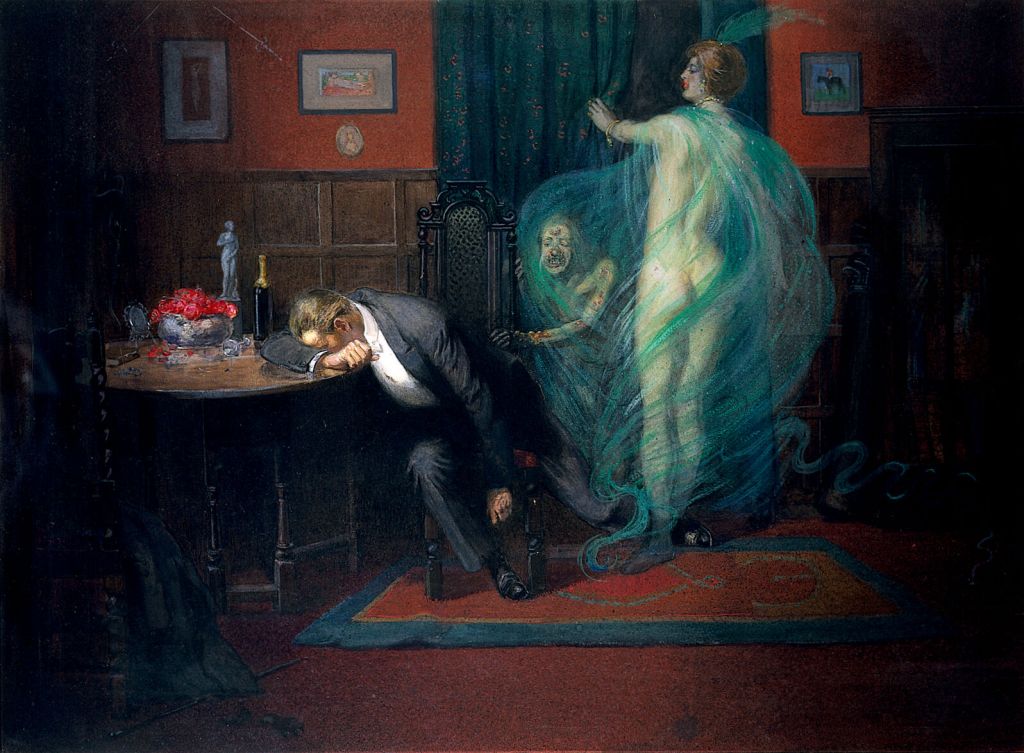
It should therefore come as no surprise that the allegorical figure of syphilis was often depicted as a fallen woman. Relatively unknown artist Richard Tennant Cooper was commissioned around 1912 by pharmaceutical entrepreneur and collector of medical artifacts Henry Wellcome to complete a series of illustrations depicting common ailments. The series, done in watercolor, gouache, and pencil, features sickly bodies with ghostly apparitions hovering nearby, representing diphtheria, tuberculosis, the bubonic plague, or breast cancer. Syphilis is unique for being the only ailment represented twice.
The first of Cooper’s syphilis paintings shows an Edwardian man slumped over a table in a well-appointed drawing room (fig. 1, above). His clothes and decor suggest general good taste, with art that nods at such standard interests as horses and tastefully nude women in their more respectable forms. An odalisque lies prone in a painting, and a statue coyly covers her breasts and genitals. It is a sharp contrast to the other figures in the room, obvious intruders in this land of propriety. A heavily made-up woman moves to draw back a curtain, clothed in nothing but jewelry and an improbable swath of sparkling green fabric that seems more cloud than textile. A grotesque figure reaches out from beyond this billowing suggestion of material, face disfigured by the lesions and tumors that are characteristic of late-stage syphilis. The knocked-over wineglass and slowly dying roses on the table suggest a fall from grace, the corruption of things once beautiful.

Cooper’s second syphilis painting (fig. 2) shares numerous similarities with the first. The culprit is once again represented as an accessorized, rouged woman, though there is no pretense of fabric this time. She lays posed on the bed, while another monstrous figure (in this case, a skeletal Death) waits. Both of the women gaze upon their respective male counterparts, and in both cases, he is turned away, one arm slung across his eyes, as if he can’t bear looking upon his fate. Should the nude man face the view ahead, he would see a mass of teeming, sickly, impersonal bodies: fellow victims of the disease. The viewer gets the sense that by taking a mere few steps forward, he, too, will be stripped of any individuality or health, becoming one with the swarm.
Syphilis is a disease that is heavily associated with visuality. Its depictions often play on the idea that a beautiful body could be hiding something grotesque, a trope that would continue well into the twentieth century. Cooper’s male figures speak to this anxiety. They could not identify something that was so clearly a threat before the fallen women and their monstrous companions got their claws into him. He is unable to trust his own gaze. The viewer is both affirmed in their ability to recognize the danger to a healthy body (after all, we’re afforded the helpful reminder of the monstrous creatures that peer from beside the women) and issued a warning: one must not fall for the same mistakes that our male stand-ins did. In the real world, our own gaze cannot always be trusted, so we must be sharper, more careful, before we find we are unable to look at ourselves at all.
Venereal disease was always seen as something that could, and should, be outsmarted, ever since Fracastoro listed a number of ways one might avoid such an unpleasant fate. The prostitute is not afforded the chance to ever be anything better than her nature. As in Cooper’s paintings, she remains detached, gazing cooly upon the men she has sentenced to suffering, perfectly content in her jewels and makeup. She is the obvious villainous counterpart to the virtuous woman, those daughters of Venus Fracastor hopes to protect. She is the right hand of the grotesque figures, and it is her gaze that condemns, her body that portends devastation.
Works Cited
Barnett, Richard. The Sick Rose, or, Disease and the Art of Medical Illustration. D.A.P./Distributed Art Publishers, Inc., 2014.
Fracastoro, Girolamo. Hieronymus Fracastor’s Syphilis. The Philmar Company, 1911.
Spongberg, Mary. Feminizing Venereal Disease : The Body of the Prostitute in Nineteenth-Century Medical Discourse. New York University Press, 1997.
Image Credits
Syphilis. Gouache by Richard Tennant Cooper, 1912. Attribution 4.0 International (CC BY 4.0). Source: Wellcome Collection.
A provocative naked young woman lying on a bed, death (a cloaked skeleton) sits at her side, a naked man walks away from the bed with his head bowed, towards a throng of diseased and dying people; representing syphilis. Watercolour by R. Cooper. Attribution 4.0 International (CC BY 4.0). Source: Wellcome Collection. https://wellcomecollection.org/works/hy6v54k2