Elsa Schiaparelli (1890 – 1973) was as much an artist as she was an anatomist. By this, I do not mean to contend that her experience lay in the meticulous work of anatomy labs or dissection theaters, but rather that her sartorial silhouettes, bodices, embroideries, and embellishments demonstrate a singular sort of reverse dissection that Renaissance practitioners could only dream of—the dissected organ along with a live, moving body. Of course, the externalized gilded bronchial tree and torn fleshly prints do not come from Schiaparelli’s models but rather from rare metals, fine cloths, and hours of dedicated craftsmanship, as the Victoria and Albert Museum in London underscores in its “Schiaparelli: Fashion Becomes Art” exhibition (running until Sunday, November 15th, 2026).

Her collaborations with artists including but not limited to Dalí, Picasso, René Magritte, and Andy Warhol are celebrated even today, and the fashion house continues “to offer 21st-century women the essence of bold style and timeless allure.” Dressing superstars ranging from Lady Gaga and Hunter Schafer to Isha Ambani and HoYeon Jung, Schiaparelli has a lengthy curriculum vitae despite Coco Chanel’s reference to the designer who diverged from normative Parisian style by incorporating surrealism into her work as “that Italian artist who makes clothes.” Though Schiaparelli’s pieces have garnered acclaim for their embodied forms and the ways in which they mirror internal bodily components, they ask a much more fascinating question: can the garment itself become a body? The distinction between the body and its representation begins to collapse here; the garment does not merely depict an anatomical structure but rather assumes its place, presenting itself as a second organism whose relationship to the first remains disconcertingly uncertain. If the body is ordinarily understood to precede the clothes that adorn it, Schiaparelli’s work invites us to consider the possibility that the body is instead a temporary inhabitant of an already constituted form.

This observation that Schiaparelli is hyperfixated on anatomical form is by no means a novel one; in fact, as Pauline Borgogno has noted, “since its origin, the House has cultivated an almost mystical fascination with anatomy, inherited from Elsa Schiaparelli herself, who saw in the fragments of the human body—eyes, lips, hands, ears—so many symbols capable of unsettling the gaze and awakening the imagination.” With even the most fleeting glance at the house’s now-viral accessories—from its face bags to its hand clutches—it is evident that indeed, “anatomy becomes a living, sculpted, stylized, and exalted material.” For Borgogno, this fascination with the body allows Schiaparelli to consistently distort the line between living, moving bodies and ornamental, artificial, and stylized appendages and organs. For critic Anders Christian Madsen, the “second-skin fabric constructions” replace “materials with latex and silicone, slicing into them like they were fabric… or, indeed, skin.” Indeed, as critic Sagra de Manueles contends, “anatomy has been one of the most distinctive signs of the maison,” and the 1938 “Skeleton Dress” (a collaboration with Dalí) is “an artistic manifesto” in which the body “is explicitly revealed” with “anatomical fragments transformed into visual elements made into garments.” Marylaura Papalas asserts that it “unmasks the very core of the body, giving a tactile quality to something conventionally impalpable” and the “Tear Dress” similarly “brings the inside of the body to the surface.” Though Papalas has interpreted such artistic moves as liberating insofar as they externalize the feminine interior (in a sort of freeing spectacle), she also rightly acknowledges that Schiaparelli derided and mocked English suffragettes and shrugged “off such efforts at women’s independence.”
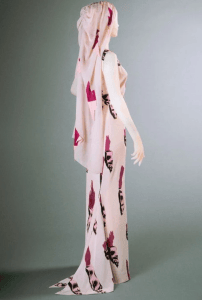
There is, nevertheless, undoubtedly something peculiar about the anatomical body Schiaparelli produces: it is not the body of the person wearing the garment. The gilded rib cage does not expose the wearer’s ribs and the torn flesh dress does not reveal the skin beneath it. Instead, the garment produces a second, perhaps parallel anatomy—one that can be seen precisely because the living body remains concealed. What appears to be an act of anatomical exposure is actually an act of substitution. Thus, Schiaparelli’s garments do not merely bring the inside out; they replace the inside with something else entirely. Daniel Roseberry, Schiaparelli’s current artistic/creative director, quoted Cristóbal Balenciaga, who famously said, “you don’t need a body when you come to me. I’ll give you a new one.” Indeed, to give someone a new body is also, implicitly, to suggest that the body they arrive with could do with some additions, changes, or glamorizing. The question is thus no longer simply how fashion represents anatomy, but rather what happens when the garment begins to compete with the body for the status of the body itself?

Drawing from Joanna Entwistle’s work, Corneliu Dinu Tudor Bodiciu asserts that the dress becomes “an organ that expands the boundary of the physical body not only through the addition of other-than-body matter to the fleshly matter of the body but also through a new range of sensorial experiences through which the body is and feels with and through dress.” For Bodiciu, the relationship between the body and the dress is a symbiotic one, in which both simultaneously influence and inform each other. I underscore that it is the artistic rendition of appendages—and not the wearer’s own body—that is often on full display. The wearer is but a mostly hidden organism inhabiting an already existing body form. What if the relationship between body and dress is not one of extension, but of occupation?
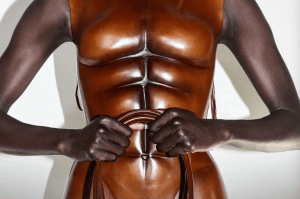
To interpret Schiaparelli’s garments through this framework is to reconsider the presumed passivity of the material object. Her garments have their own skins, skeletons, and anatomies; they require the human body to animate them, but also impose a form upon the body that inhabits them. The wearer may supply movement and the spectacle of life, but the garment supplies an alternative bodily structure (one that may even eclipse the organism beneath it). Placing medicine in conversation with fashion, does Schiaparelli, deliberately or unintentionally, render us humans mere parasites inhabiting the host bodies of her bodily frames until they fade out of vogue and we move onto the next ones?
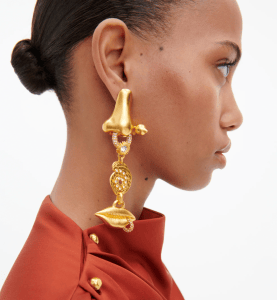
Or perhaps parasitism is not entirely accurate, as Schiaparelli’s use of anatomy also seems to suggest that fashion and expression can serve as cages. Indeed, her gilded breastplate appears to literally cage the body in, despite symbolically uncaging the lungs from the rib cage. Do we slip on the artificial toes, symmetrical noses, plump lips, and hollowed-out ribs until we ourselves become them? If Schiaparelli’s garments produce a second anatomy—one that can eclipse the living body beneath it—then perhaps the dressed body is not a stable organism adorned by an external object, but a contested territory in which the boundaries of the self are always being (re)negotiated. What happens when the body can no longer tell where it ends, or, still more pressingly, when what it wears begins to look more alive than the flesh beneath it?
Featured Cover Image: Schiaparelli. Mesh Corset with Exoskeleton Structure. Source: The Pink Lookbook.