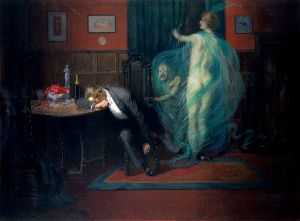
Far from passive recipients of questionable treatments, nineteenth-century asylum patients formed their own opinions on what constituted effective care. Patients’ critical views occasionally appeared in asylum periodicals that were published throughout the nineteenth and twentieth centuries with various degrees of patient involvement. Though institutionally supervised, these publications platformed views that challenged contemporary medical ideas and proposed new models of treatment.
One instance of dissent is found in an 1852 review of a popular medical treatise titled The Dietetics of the Soul by Dr Ernest Von Feuchtersleben, published in the Morningside Mirror of the Royal Edinburgh Asylum in Scotland. The reviewer was Alexander Smart, a printer, poet and self-proclaimed “commonplace hypochondriac”, who took issue with the physician’s representation of mental illness as a moral failure of the will. Smart challenged Dr Von Feuchtersleben’s extreme self-determinism, drawing on his own experience as a source of knowledge:
“Having […] soared to the giddy heights, and sounded the lowest depths of human suffering, [I] might be tempted to laugh to scorn the philosophical theorising of a mind at ease” (Smart 18).
According to Smart, true insight into the ailing mind was inaccessible through rational reasoning.
Unhappy with the doctors’ treatment at the Stirling District Asylum, “A Sufferer” writing for the Passing Hour in 1901 reasoned:
“what’s the use of a man setting himself up to try (by his way of it) to cure a person’s mind he cannot see the bottom of. Till once it is stipulated that no one shall have rule in Lunatic Asylums who is not all round wise, it’s no use. Get someone to make a new law of lunacy” (5).
There is no evidence that these publications had a significant influence on legislation, but they unquestionably encouraged bonding and solidarity among patients.
Asylum periodicals were also platforms for providing peer support. The frustration with prolonged confinement and the inadequacy of treatment occasionally drove patients to seek advice from each other. A letter to the editor of the Gartnavel Gazette, published in the 1850s in the Gartnavel Royal Hospital in Glasgow, seeks advice on finding peace at night, as the author, hidden behind the dreamy pseudonym “Jacob Somnium,” was tortured by disturbing dreams. He begs the editor:
“Will you be good enough […] to furnish me with your opinion as to the feasibility of checking these disorders of the imagination? If you can do nothing more for me yourself, will you at least have the goodness to give publicity to my letter, as I may have a fair chance of getting a useful hint from one or other of your readers?” (“Correspondence” 2).
The editor, himself a patient, obliged his reader. The letter was published in the Gartnavel Gazette on 10 May 1855, accompanied by the editor’s appeal to the readers:
“Are there any of our friends who can ‘minister to a mind diseased?’ If such be the case, we would recommend ‘Jacob’ to their notice” (“Correspondence” 2).
A closer look at the literary reference embedded in this response uncovers a subtle mockery of physicians’ inadequacy. In Shakespeare’s Macbeth, Lady Macbeth’s sleepless madness drives Macbeth to ask the doctor: “Canst thou not minister to a mind diseased?” The doctor admits the limits of his powers, advising that “the patient must minister to himself.” Macbeth answers with frustration: “Throw physic to the dogs; I’ll none of it.” Weaving a reference to this episode in his response to his fellow patient, the editor of the Gartnavel Gazette points a finger at the physicians’ failure to aid his correspondent. It seems that, like Macbeth’s doctor, the asylum physicians had left the patient to take care of himself. And so he did – by turning to his fellow inmates.
This communication with the editor highlights asylum periodicals’ potential to produce alternatives to the doctor-patient model of care. In this case, a person already receiving professional treatment seeks advice from fellow sufferers rather than doctors. As much as frustration and despair, the letter of “Jacob Somnius” embodies solidarity and trust. It also shows recognition of patients’ valuable expertise on mental distress and its alleviation, which is sought when the physicians seem to be powerless.
Though hiding in institutional archives and wrapped in cryptic language and intertextual references, such instances of defiance and critique are precious reminders of patients’ participation in defining and treating mental distress throughout history. Asylum periodicals bear witness to patients’ early advocacy of lived experience and peer support. Two centuries later, we can observe the legacies of these efforts in a renewed interest in what lived experience experts can offer to the provision of care (Watts and Higgins; World Health Organisation).
Works Cited
“Correspondence”, Gartnavel Gazette, pp. 1-2. Wellcome Collection.
Shakespeare, William. Macbeth from The Folger Shakespeare. Ed. Barbara Mowat, Paul Werstine, Michael Poston, and Rebecca Niles. Folger Shakespeare Library.
Smart, Alexander. “Moral Dietetics.” Morningside Mirror, 15 December 1852, pp. 17–20. Lothian Health Services Archive.
“A Sufferer.” “Doctors.” The Passing Hour, July 1901, p. 5.
Watts, Matt and Agnes Higgins. Narratives of Recovery from Mental Illness: The Role of Peer Support. Routledge, 2016.
World Health Organisation. Transforming mental health through lived experience: roadmap for integrating lived and living experience practitioners into policy, services and community. 30 June 2025.
Image credits:
A little dog attacking the ear of a blood-hound; representing doctor-patient relationships. Lithograph after E.H. Moore. Wellcome Collection.