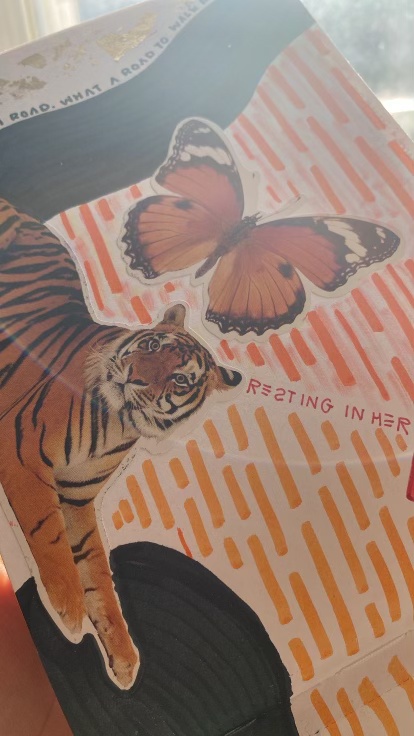
what would it mean to learn love for multiplicity from the site of black girl longing?
[This Series is a conversation between my interior and the interior of Ada, Freshwater’s protagonist. As a Black girl who, at times, has experienced multiple selves, I allow my messy insides to narrate a semi-fictional account that reflects my spiritual experience of journeying with this book. For the finale of this three part series, I invite guest author Ifechukwu to do the same.
*If you have not yet read Part One and Part Two of The Dear Asughara Series, please read that before you read this. You will need it for context and clarity, guidance and grounding.
. . .
THE DEAR ASỤGHARA SERIES: PART THREE
–
I.. ree, internal dialogue with inner world
wild child
i have stories to tell
about my insides
stories about spirits
and souls and ghosts
stories about soil
and sorrow
tomorrow
i will tell you
exactly how i arrived
today, i come in peace
/
me, to wild child
i am in no war, no battle
if you are fighting,
it is alone
i know goodness
of girlhood divine
it is time
for us all
to remember
/
me, to everyone
i have african twins
soiled in my womb
twin sisters with truths to tell
/
wild child, to me
soon you will see
how and why i came
but today is for the girls,
for their youth
/
me, to everyone, about wild child
freedom girl
disarms her
helps her see
there’s no need
for the flame
not here. not now
we’re healing
she is a part
of the process
i know
but she must
know her place
her boundaries
freedom
is the girl
who asks
the wild
twin sister
to soften
her shame
freedom girl
still has hope
for this life
because
sand and grass
guide her home
to me. because
toes now know
they share of
soft ground
kisses
i can’t tell you
how many times
she finds herself
laughing at the sun
finding sweetness
is the simplest
of things
there is room now
to notice
when god says
hello. when the
tree branch waves
and the wind birds sing
there is room now
to notice
the niceness of things
because home is
quite safe
and quite loving
there is room now
to stretch into the softness
for the girls who would like to
come close, i whisper
to her corner of the wild,
come close, sweet shadow,
we’ll grow..
.
.
.
.
.
II.. ifechukwu, internal dialogue with inner world
ifechukwu, to my 5 year old baby parent
you split off when she abandoned me.
you split off when she abandoned me.
you split off when she abandoned me.
when she abandoned me, you split off.
you’re split off.
you split off to take her place, split off to be my new parent, you split off to be my mom. you split off to become attuned to me. you split off to become attuned to me because she was no longer attuned to me. she was attuned to me and then one day she was gone and you were born and you split off to keep me alive. the times where I got lost in the TV, that was you that was you finding ways for me to cope. that was you trying to soothe me while making sense of your new job. that was you trying to buy some time it was you trying to help me take a break from the pain I was in, the horrendous pain of that first loss, that original split, and yeah you sent me off to spirit world. you sent my spirit away. you sent my spirit away to the world that was in the TV so you could assess the damage, so you could get familiar with our environment, your new home and so I wouldn’t be confused because you didn’t even know who you were. you were also just a baby. you’re a baby who had to take on mothering me, who had to give me life, to keep me alive. you’re a parent to fight, you were parentified, you were parentified, you do understand, you’ve been here for all the terrifying times. you’ve been here for it all.
you’ve seen it all and then the moment I was making food and I was feeling proud and I was feeling comfortable you were proud of me and you sat back and you let me feel happy and then the moment I realized and you saw that I missed therapy you came down with a vengeance. it was like you were woken up from sleep by being caned. it was like you got caught being happy. in order for me to live in this prison, you had to be here with me. you had to be in it with me. you had to be able to feel everything i’m feeling. you’ve also felt like you weren’t good enough, you’ve also felt like if you felt like everything was OK and you calm down from doing your job that I would DIE. f*ck. I can’t imagine what it’s like for a child to feel responsible for whether or not another child lives or dies…not. you know me so well you are my friend. you felt my pain, you felt my pain, you feel my pain, you have and I just want you to know that I recognize you are you, you are you are here and I’m talking to you and all those years that I felt like I wasn’t good enough it was all you keeping me alive.
.
.
.
.
.
III.. ifechukwu & ree, Critical Black Feminist Perspectives on Internal Family Systems
The Dear Asüghara Series is grounded in a critical Black feminist interpretation of Internal Family Systems (IFS). IFS is an evidence based psychotherapy modality used in the treatment of complex trauma. As we engage our individual and collective healing journeys alongside Freshwater’s Ada, we identify IFS as a framework to explore the meeting and integrating of split parts that might be stuck in past trauma. IFS approaches healing with the view that the mind is made up of relatively discrete subpersonalities, each with its own unique viewpoint and qualities which need to be acknowledged and healed. Complex trauma is associated with splitting, which involves a division within and between the “normal self” and the “traumatized self.” This splitting is often pathologized by the mental health industrial complex (Greene, 2023) and thought to result in symptoms of “mental illness” — unpredictable mood swings, identity confusion, and a deep sense of emptiness. What has not been adequately acknowledged by psychiatry is that these parts developed to play a role in surviving traumatic childhood experiences, and though they may be deeply attached to trauma, they may also, over time, bring healing.
As a result of healthy support systems and culturally relevant care, we have been able to experience our parts as sacred portals and spiritual gifts. They bestow us with expanded capacity to feel the necessary sorrow that trauma-informed healing requires. They also enrich our capacity to experience profound joy, heartfelt pleasure, keen intuition, and a depth of ancestral connection. Therefore, we assert that our multiplicity is the foundation for our wholeness; it is not pathology. We view ourselves, like Ada, as multidimensional beings with the gift of sacred attunement, which invites us to be profoundly present with the entirety of our true selves.
With this series, we energetically hold space for the collective experiences of folks whose Black girlhoods gifted them the power of multiplicity; whose cosmologies are currently unrepresented in health science landscapes which attempt and fail to understand our inner worlds. It is our hope that this series offers you and all your parts a soft place to land.
.
.
.
.
.
Notes, References, and Resources:
*We do not intend to romanticize nor minimize the real lived experiences of folks who experience multiplicity as deeply disturbing and traumatic. We do, however, want to show that there are some folks, like us, who experience their multiplicity as a sacred guide to healing, even when it is, at times, really heavy and hard. If you or a loved one is experiencing multiplicity in disturbing and traumatic ways, we encourage you to seek help. You may begin with the resources below. It was as a result of our seeking help that we were able to find healing through multiplicity.
Resources
National Alliance on Mental Illness, Resources for Black Families
Loveland Foundation – Free Therapy for Black Women & Girls in Need
Open Path Collective – Low Cost/ Sliding Scale Therapy
National Queer & Trans Therapists of Color Network
References
Development of the internal family systems model: Honoring contributions from family systems therapies – Elizabeth G. Brenner, et. al
https://onlinelibrary.wiley.com/doi/epdf/10.1111/famp.12943?domain=author&token=XPGXUNYFXKYREKD7JZUS
Evolution of The Internal Family Systems Model – Dr. Richard Schwartz, Ph. D https://ifs-institute.com/resources/articles/evolution-internal-family-systems-model-dr-richard-schwartz-ph-d
The Internal Family Systems Model Outline https://ifs-institute.com/resources/articles/internal-family-systems-model-outline
Black Therapists Rock & IFS
The Mental Health Industrial Complex: A Study in Three Cases, Eric M. Greene
The Viral Wake Up Call: An IFS Perspective
https://ifs-institute.com/resources/articles/viral-wake-call-ifs-perspective


